Like Mother…and liking it

No wonder I’m a runner. Just look at my mom. No, she’s not a runner. I have, in fact, no memory of seeing her run anytime, anywhere, in my entire life, ever. No. She’s decidedly not a runner.
She’s a shooter, and a darn good one. This year, she will be inducted into the National Skeet Shooting Association Hall of Fame. Quite an accomplishment, and one I am profoundly proud of her for.
You’d think with a mother possessing that kind of ability I’d become a shooter myself. Not a chance. I was never patient enough to shoot well. Plus, the whole thing seemed so involved. Too much equipment—and then you have to clean it. Too much effort to go somewhere other than out my front door to practice. No thanks. Not for me.
For a long time, I didn’t quite understand her obsession—for lack of a better word—with skeet. It wasn’t until I took up running in my early 30s that I began to understand how a person could spend so much time and so much effort doing something that seemed so, well, frankly so insignificant.
But my mom’s obsession is not with obliterating little orange targets. As mine is not with becoming perpetually faster. Medals aren’t the goal for either of us. Becoming a better person is.
In the past several years, I’ve come to see several parallels between running—a pursuit that requires no other equipment than a pair of shoes, can be practiced anywhere at any time, and can result in a conditioned body—and skeet shooting—an endeavor that requires expensive equipment and accessories, must be practiced at a specific venue, and rarely produces an increased heart rate.
Every time we step onto the playing field, we’re competing primarily against ourselves. Sure, it might be nice to actually win something, but becoming good enough to win consistently takes time. Hours and hours of time. Dedication. Persistence.
The goal I want to achieve at almost every event is to do better than I did the last time. Sometimes, my goal is simply to finish, uninjured. But I’m my own biggest rival. My most enthusiastic cheerleader and my worst enemy. Yet with competition comes the confidence acquired when reaching a goal as well as the quiet grace and humility attained when giving it everything yet falling short.
So we practice, because practice breeds perseverance. It makes us better, faster, stronger. More accurate, more consistent. This is, of course, true of any sport, but I’ve seen both shooters and runners practice in the absolute worst conditions. I long ago stopped chiding my mom for spending hours outside in the brutal Michigan winters or the searing Texas summers. How can I chide her when I have practiced my own sport in typhoon stage 3 readiness or cold so piercing that icicles formed on my hat, scarf, and mittens?
I realized, during one particularly cold run when I initially could not feel my legs, that we both live a sort of Senecan philosophy: If one prepares for the worst, she will be more likely to do her best when it counts. It is what self-discipline is made of.
Running and skeet shooting both are solitary endeavors. You might be surrounded by people, but most of the competition is meted out in your head. Your success depends largely on what you believe you can do.
But both are team sports too. Your friends are also your competitors. Mostly, they genuinely want to see you succeed. But they also want to succeed themselves. On the field, you are simultaneously together and alone, so deep in your own head that you could very easily lose the connection with the person standing right next to you.
But you don’t. Because you recognize the critical role support plays and how sometimes the difference of just one word of encouragement (or spite) can make or break you.
Ultimately, both sports are a test of character. Ultimately, neither running nor shooting is a game. How you show up in each is how you show up in life. I’ve seen people I thought were kind and compassionate off the playing field turn into mean, puerile creatures on. And I’ve been pleasantly surprised witnessing an act of kindness from a stranger.
At heart, what we are when we compete is who we are as people.
In all these years, my mom’s character has been refined by shooting. She possesses a quiet confidence in her ability yet a humility I sometimes find bewildering. She continually and sincerely roots for the success of strangers as well as friends. And I have never seen a more graceful loser. I am lucky to have her as a role model, a mother, a friend.
No wonder I lead an organization that inspires joy, health, and confidence in young girls. Just look at my mom. That’s what she inspired in me. In fact, she still does.
She took up shooting at a time when women were not allowed to be members at some clubs. At a time when girls didn’t do such things as shoot guns, get dirty, spend time outside in the cold and rain, in spaces dominated by men. Her family, some friends, much of society gasped in disapproval and said, No, you can’t.
With the determination and dignity she’s always possessed, my mother said, Really? Just watch me, and went on to become one of the best.
How many times in my life has that pernicious voice at my ear told me, No, you can’t. Sometimes that voice is my own. Yet there my mother is, standing beside me, in quiet faith insisting, Yes, you can.
Read Full Post | Make a Comment ( 3 so far )Why Change?
Last time I checked, it’s still January. We’re just over halfway through with it and already change is hard. I didn’t make any New Year’s resolutions. Not really. I simply realized (once again) the need to be deliberate, to be present, since the present moment is all we are truly given.
A fortune from a cookie is pinned above my desk to remind me: “A focused mind is one of the most powerful forces in the universe.” I vow to start each day, before I ever get out of bed, focused with a prayer first of thanksgiving for this day, and then for guidance: Wisdom in my decisions, prudence in my actions, compassion in my communication. Then and only then will I allow my mind to be crowded with all there is to be done today.
But, as it turns out, even as small a change as this is hard to make. Just yesterday morning, for instance, my alarm went off at 5. I knew all the things I had to do that day, as I do every day, because I keep a calendar and a to-do list, both of which I review frequently. I planned to get up and run, then write, then work from home for a couple of hours before some afternoon meetings. If I didn’t get up in time, something would have to give. And I knew that something would be either my running or my writing, neither of which I am willing to sacrifice.
I have changed the way I think about both writing and running. I don’t have to do them every day, only some days, and on the days I choose to do them, I do them deliberately. So much pressure removed, so much focus added. Both activities improve tremendously, and so does my attitude about them.
But yesterday morning at the sound of the alarm, rather than starting my day with a prayer, I started with the rapid blur of mental gymnastics as I thought about how to change my day’s already-established plan:
I don’t really have to put in eight miles today I can do it tomorrow because tomorrow I have a running meeting on the Salado Greenway Trail at 11 and we’ll probably run four miles so I can always go early and put in four before or stay later but I can still get up at 5 to get my writing in because if I do run then instead of now that cuts into tomorrow’s writing time and…
It was cold and dark, you see, and I had eaten too many Cheetos the night before. I just wanted to lie in bed a little longer, until my stomach didn’t feel queasy. Or until spring.
And then it hit me. This whole idea of change. Not only that I was bucking against my own self-imposed new system, but that there was another change I needed to make too. I couldn’t go to the trail to run alone. Because that would be stupid. Unsafe. And the one change I felt compelled to make after New Year’s Eve was to not run alone in secluded places. Not since Lauren Bump’s murder.
So I rolled out of bed and got ready to run in a place that may or may not be safer than a trail: my neighborhood. I’ve always thought of my neighborhood as safe, just as I’ve always thought of the trailway as safe. Now, in my mind, they are equal. And now, for the first time in my life, I carry pepper spray. Another change to get used to.
Read Full Post | Make a Comment ( None so far )Processing a Runner’s Murder
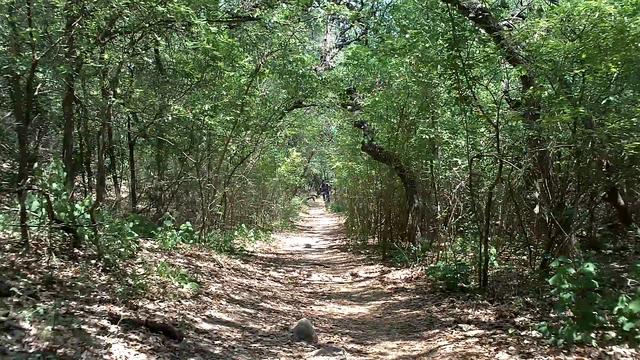
On New Year’s Eve day, 24-year-old Lauren Bump pulled into O.P. Schnabel Park on the west side of San Antonio sometime shortly before 3:00 pm. I imagine she stood outside of her car and stretched, leaned her body left and right, arms overhead, lengthening her IT bands. She may have grabbed an ankle, hiked it up behind her, pulled gently, first one side, then the other.
I imagine she found her favorite music on her iPod, stuck her buds in her ears, and took off at a slow and easy pace down the trail, out onto the Salado Greenway. She probably inhaled deeply, looked up into the sky, taking in the sun and birds and tranquility of the trails. It was perfect running weather, mid-50s at 3:00, and she smiled as she settled into her run.
I can imagine all of this because it’s what I would have done had it been me out there running. It’s what I do each morning I go out for a run, gratefully anticipating the peace and time and space. It’s what I need. What keeps me right with myself, with the world.
Only, now, my peace is gone. Not only can I imagine Lauren setting out for her run, I can also imagine—in horrifying detail—how she must have felt, blindsided by a maniac with a knife slicing away her tranquility, her promise. Her life.
Like the rest of San Antonio and the running community here, I am stunned by Lauren’s brutal murder. In broad daylight. In a public and well-used area. I cannot imagine how her family must be reeling at their loss. I cannot imagine how someone could do such a thing.
And I cannot get past my anger. Of all the many things associated with Lauren’s murder—I cannot call it her “death,” as that word seems too passive, implying no agent of action to have caused it—to be angry about, I’m not sure which weighs most heavily.
Perhaps it’s that I feel the need to change my way of life, one that I was happy with on December 30. Maybe it’s that what’s driving the impetus for change is not the desire for self or community improvement, but fear. Nothing angers me more than fear. Usually, its presence makes me want to face its source head-on. But this time, I feel like I can’t, because it’s not a man I’d be facing. Or a tall building or a nest of spiders or den of snakes. Rather, the source of my anger is the knowledge that what happened to Lauren could have happened to anyone of us, any time, any place.
I choose to see the best in people because I like to believe that we all have something good and decent within us, that we are all capable of greatness. I choose to see the promise in humanity.
But all the while, I know there are people out there like the man who murdered Lauren, and I see the flaw in my vision. What do we do with people like him? I don’t have an answer. Do you?
Read Full Post | Make a Comment ( 5 so far )Hill Repeats, or why dog poop can be your new best friend
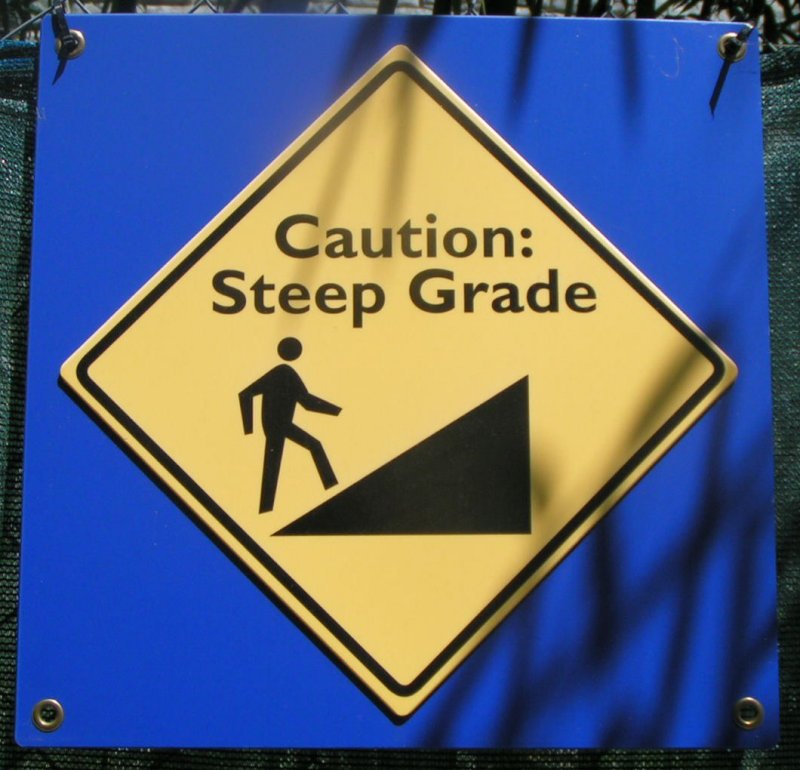
Carrie and I are at it again. Another half marathon, another training plan under way, working toward the Austin half marathon on February 16. We are using the same training plan that got us through the San Antonio Rock ‘n Roll half marathon just a few weeks ago.
Which means we start with hill repeats. Temple Hill. The nearly half-mile, pretty darn steep monster hill we conquered last time around. Only it doesn’t feel like a conquest. It feels like an initiation.
Monday. Four to five short hills were on the schedule. Half way up Temple Hill, or the equivalent of six lampposts.
We braced ourselves at the bottom, walked in circles, mentally preparing for the trek. I leveled my gaze on the ground in front of me as we started the first repeat. We chatted two-thirds of the way up, counting lampposts.
On the second repeat, I noted objects to guide me. Look for those markers, and I don’t have to count. A rust-colored sign at lamppost two, a screw in the middle of the sidewalk between lampposts three and four. A pile of dog poop at lamppost five.
I grimaced when I first saw it. Some poor soul had already imprinted his shoe with it, and I was immediately angry. What kind of moron let’s their dog poop smack in the middle of where people walk?
By the third repeat, I was breathing too heavily to be angry with the pile or its owner’s owner. I remembered it was there, looked for it, ran around.
By the fourth repeat, I was almost glad to see it, sitting there near lamppost five, not so far from the end.
By the fifth repeat, I actively sought it out, raised my head in anticipation. Why is it taking so long to come into view? Is that it up ahead? No, that’s a leaf. Where is that darn poop?
Finally, after what seemed like an eternity, there it was, like an old friend waiting patiently for my arrival. I was never more happy to see something so foul, so repelling, yet so close to the finish that I wanted to sing. Instead, I breathed deeply and smiled in relief as I crossed the line.
That wasn’t so bad, we said as we bounced down the hill, instinctively avoiding the pile. We did it, we sighed. We reached our goal.
***
Tomorrow is Girls on the Run of Bexar County’s Fall 2013 5K, the culminating event for our season, where our girls get to experience first-hand what it feels like to finish something they’ve worked for 10 long, hard weeks to achieve. The excitement is palpable, among the coaches as well as the girls. We hope that the confidence the girls gain when they cross the finish line travels with them to every other area of their lives, for the rest of their lives.
I know they are nervous going in. If I could offer them just one bit of advice, it would be this. You don’t have to embrace the dog poop you encounter on your path, but you don’t have to fear it either. For all you know, that pile of poop could very well be the harbinger of joy and relief, of much better things to come. Step around it. The finish line is waiting.
Read Full Post | Make a Comment ( None so far )Recovery Doesn’t Have to Keep You Down

Courtesy 2milliondogsblog.wordpress.com
It’s been 3 years since I’ve run San Antonio Rock n Roll half marathon, and now I remember why. The weather in San Antonio is fickle. Last Sunday, race day, saw a record high of 89°F. This Sunday, we’re expecting a high of 42. Go figure. Nevertheless, it was a fun race with a great route. I’ve spent this week recovering, including not running but doing some stretching, strength training, and core work instead. I’d forgotten how much Pilates hurts.
Because of the heat on race day, it was a hard recovery. But following these tips helped ease the pain.
Ice, ice, baby
I know. I can’t believe I said that either. But an ice bath is the way to go. Get in the tub, run a couple of inches of warm water, switch the warm to cold until your legs are covered, then pour in the ice. Bags of it, to the tune of 30 lbs. You may need to wear your cold-weather running shirt in the tub with you. And you probably need to be clutching a very large cup of very hot liquid, but ice will ultimately make your legs happy. By the next day, they’ll be thanking you.
Hydrate
This was the first race where I hit every single water stop. With all that heat, I needed it. Drinking the day before and during the race, however, is not enough. I drink all day long after a race ends. I don’t mean beer, although there’s nothing like an ice-cold beer after a hard, sweaty run; I mean water and electrolyte-replacing liquids. You won’t wake up Monday morning feeling hung over if you keep the liquids coming.
Feed your body well
My body always feels weird the entire day after a hard race. I feel depleted and want to eat, but nothing sounds good. I’m often tempted to eat pizza or Cheetos. Racing is a nice excuse to offer myself that kind of reward, but there’s something about a greasy, cheesy slab of dough that just doesn’t sit right with me. Then again, neither does a steak. I can never decide. I find that I have to practically force myself to eat something, and I have to rationally choose the foods best suited to recovery, the right combination of healthy carbs and protein.
Fortunately, I survived the race—and the ice bath. When’s the next race?
Read Full Post | Make a Comment ( None so far )The Journey Up
The Angel Moroni stands erect, head high and horn to lips at the tallest point on Stone Oak Parkway. I’ve marveled at this golden statue perched atop the San Antonio LDS temple for the past few years. The temple itself stands at the pinnacle of one of the highest hills in the area. You can see both the temple and the statue from quite far.
This hill has been my nemesis, my nightmare—my dream, my goal—for years. Each time I’ve driven it I’ve thought that maybe one day, maybe one, if I was lucky (or crazy), I would maybe give it a run. And, if a miracle happened, I would make it to the top.
Until now, I have trained for nearly every half marathon alone. My friend Carrie is training for her first half, and we are using the same plan, one that calls for hill repeats as one of its two days of speed/strength work. We are both trying something new: Carrie, a half marathon. Me, a running buddy. We don’t run together every day. Just the hard ones. The longest of the long runs. The hills.
The hills. We figured if we’re going to run hills, we might as well run Hills. So we chose temple mount.
Last week, our first hill week, we stood at the bottom of the mount and looked tentatively up. We couldn’t see the top from the bottom, could barely see a jutting temple corner and the Angel Moroni heralding the dawn. Four to five short hills is what our plan directed. Our goal was to get as far as we could, maybe half way, for each repeat.
For the first repeat, we counted five lampposts, about a third of the hill, and stopped, excited. Maybe it wasn’t so bad after all. For the second through fourth repeats, we counted eight lampposts, somewhere around half way. We struggled for breath, lungs searing, and made a fifth repeat, five lampposts.
We went home thrilled with ourselves (though we would barely be able to walk the next day), determined to come back and try again.
This week, we met at the bottom of the mount. Three to four long hills, our plan said. Long.
Let’s start where we left off, I suggested. The first repeat to lamppost eight. Then we can shoot for the top.
Carrie looked at me sideways, hands on her hips, looked up the hill. I think, she said confidently, that we should go all the way up the first time. Get it over with. Then if we feel like it, we can do it again.
So we took a deep breath and began. We started up the hill in complete silence, eyes dead center on the cement in front of us. At lamppost eight I was breathing hard, lungs tight but not searing, and we kept going, up and up. Before we knew it, we were at the top, over the last steep hump, the end in sight. I eyeballed a fire hydrant where the sidewalk leveled out, my stopping point. Carrie bounded past me by two cement squares and stopped at the crosswalk.
We smiled, barely, and looked out and around. Lights twinkled for miles in the distance, the sky predawn gray. We sucked in air, high-fived, and jogged back down the hill. It seemed to take much longer going down than coming up.
The thing about doing something hard once is that in having done it you have proof that you can. It doesn’t seem right after that to not do what you just did and what you know you can. It seems that if you do not put in your best effort and repeat your success, you are only cheating yourself. And if you have a buddy, you are cheating her too.
Eight lampposts thus seemed like a silly goal for the second repeat. It was all or nothing.
This time rather than keeping my eyes trained straight in front of me, I glanced up from time to time, looking for the angel with his horn. I could see him at the peak, gold and shiny, beckoning me. I ran and glanced and ran some more, and before long the sidewalk leveled out and the fire hydrant appeared. Carrie bounded two sidewalk squares past me again.
The third time, I didn’t count lampposts, nor did I seek out the angel. I paid attention, instead, to my legs that did not hurt, my lungs that worked hard but were not searing, and my arms and hands and head that felt light as we ascended, and I thought how strange, it’s almost as if our altitude is increasing, like in the mountains, but my ears did not pop. And I remembered the hill at mile 12 of the Austin half marathon, how I cursed the idiot course planner for the giant, steep hill right there, and how this part of temple mount felt like mile 12 then, but now I was not cursing and thinking, as I was then, who does this kind of thing? Who actually pays to torture their body and run like this when they could be in bed with coffee and the newspaper? No. Instead I was running up and up and again, nearing the top, across the last stretch, fire hydrant in sight. And then I bounded past it, with Carrie, to where the sidewalk ends.
On the way down, that again seemed so much longer than going up, I told Carrie that if it wasn’t for her I would never have made it all the way. I would have quit near the top, would not have pushed myself until my arms and hands and head went light as a feather and I flew the rest of the way.
This is a much better plan than all my previous ones. Hills are so much easier to ascend with a running buddy.
Read Full Post | Make a Comment ( None so far )Rethinking Pink

I just bought a new pair of running shoes. Bright purple Asics. Very unlike me. I’ve always hated purple.
A year ago I would have balked at the purchase, told the salesperson to take them back, thank you very much, I’d rather have a pair of shoes that maybe didn’t fit quite so well but that weren’t so, well, purple.
But that was a year ago. Times have changed—at least since I bought a pair of bright pink reading glasses.
I’ve always hated pink even more.
When I say hate, I mean loathe. I mean face-squinching, stomach-churning abhorrence. Growing up, my sister and I inevitably received the exact same gift for birthdays and holidays. Exactly the same, that is, with one exception. Whatever the gift was, she got blue. I got pink.
No one ever asked me what my favorite color was. (Decidedly not pink.) No one bothered. They simply bought every article of clothing, bedding, bathing accessory in pink. And you know how it is. Pink begets pink. When one relative saw me with All Things Pink, others made wild assumptions and purchased even more pink. I was forced to live in a Box of Pink.
When I left home for college, I quickly and thoroughly cleansed my world of All Things Pink. I did not purchase one even remotely pink thing until I was well into my 30s: One sweater, a beautiful cardigan with pearlized buttons that the store did not have in black. It sat in my closet, tags dangling, for nearly a year before I wore it—and then, only because laundry was weeks overdue.
Yet just about a year ago when I decided it was time to quit fighting the fact that I need reading glasses, I found myself standing in front of a rack handling a pair of bright pink frames. Pink? I shuddered, yet turned them over in my hands, tried them on, tested them on a label I’d been struggling with in aisle 3. I replaced them on the rack and loitered in the antacids aisle.
Pink glasses. Pink? I paced the aisle, completely dismayed that I was considering buying them. Why, dear God, why would the thought even cross my mind? These glasses couldn’t sit in a drawer for a year. I would need them daily to help me see clearly the very intricacies of life, the things that were right in front of my face.
Then it struck me. Pink. A primary color of Girls on the Run.
Since becoming council director, I’ve faced some of the most challenging days of my life. There’s not a day that goes by where I have to do something I can’t do. Maybe I don’t know how to do it, I don’t have the skill set. Maybe I don’t enjoy doing it and I simply don’t want to. Maybe it’s not my strength. Or, maybe, I feel incapable. Inadequate. That if I do this thing, whatever it is, surely I will fail.
But then I do it anyway. Because it must be done.
And because, as it turns out, I can.
Girls on the Run may be about the girls—empowering them to live outside the Girl Box and to reach their full potential—but along the way, serving them has altered the way I see the world. Inevitably, what I see differently is me.
So I put back the Alka Seltzer, Rolaids, and Tums and walked out of the store with pink glasses, a daily reminder that there is another way to see.
Last year, pink glasses. This year, purple shoes. I figure a new vision won’t get me very far unless I’m willing to take it to the street, give it a good run.
Read Full Post | Make a Comment ( 1 so far )The Tortoise and the Hare
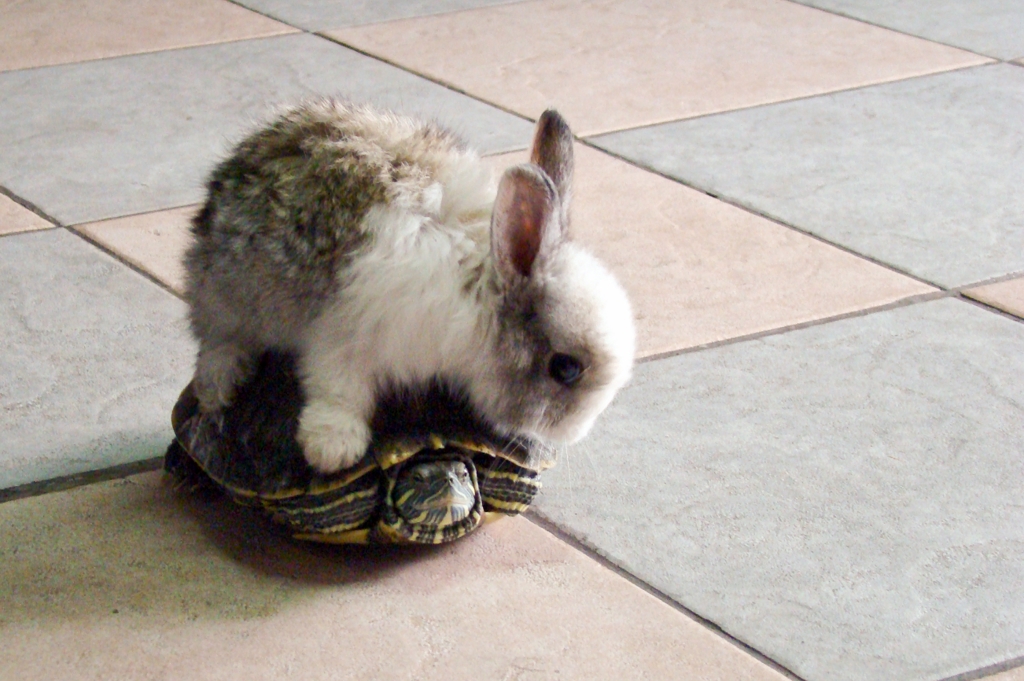
from News to Swallow, meghanandtommy.com
My friend Lissette turned 50 this year. From her friends and family, she requested a unique gift: Run the San Antonio Rock n Roll marathon with her. Her goal is to recruit 50 family and friends to run this November race. The half, the full, the relay; run, walk, skip, jump, she doesn’t care what they do or how they do it, only that they try.
Many months ago when she told me about her request, I promised to be one of those 50. Last month, I registered for the half.
I made out my training plan then, deciding to try something new. The plan I’ve used for years requires 5 to 6 days of running a week. My new plan requires only three: Two days of intense speed work and one long run, plus three days of cross training and one day of rest.
Two weeks into my plan and I can’t decide if I feel like the tortoise or the hare. Not that I’ve ever run as fast as a hare (or would consider napping in the middle of a race like the hare). But I’m finding the speed work days to be not just intense but also fun. And on the days that I run long, the tortoise mantra paces me: Slow and steady, slow and steady.
It seems that I’ve found the plan that will get me there, as one among the 50.
Read Full Post | Make a Comment ( None so far )Becoming Athena

Megan sat on the steps, fidgety and red with frustration. She blinked back tears, too proud or stubborn to cry in public.
“There’s got to be someone,” her teammates moaned. “Just pick a name already.” They, too, were frustrated. We’d been waiting 10 minutes after everyone else finished for Megan to come up with a name. Just one. Single. Name.
The goal of this Girls on the Run exercise was to identify the characteristics of a good role model. The girls were to come up with the names of women who had an impact on them. Megan couldn’t think of anyone.
Her mother? No.
Sister? Didn’t have one.
Cousin, aunt, family friend? Nope.
Surely there was a teacher or coach who had one good quality Megan wanted to emulate? Nada.
Lucy Stone, Harriet Tubman, Amelia Earhart…anyone public, famous, renowned? There was none.
Megan wasn’t the only one fighting tears. The other coach and I clenched our teeth against them too. How could a girl reach adolescence and have not one woman to look up to? We didn’t know how to feel. Frustrated and outraged for starters, but by the end of the day just plain sad.
The assistant coach—my sister—and I talked about this for weeks. We dissected our childhood to come up with the names of women who had an impact on us. We couldn’t think of many. Our mom, an extraordinary woman, topped the list, but there weren’t too many others. The fewer names we came up with, the more we felt the gravity of our role with this team of young girls. Whether we knew it or not, and whether we liked it or not, we were there to be role models. Our behavior and our words mattered in ways we would probably never know. They were watching (whether they knew it or not) to see how two ordinary women handled life.
Once I realized this, I wanted to vomit. If they only knew how many mistakes I had made, how often I still screwed up, they’d laugh me off the playground. But when my stomach stopped churning I recognized that this was part of what drew me to Girls on the Run to begin with. If I had only had someone to show me how to be, how to think for myself, how to choose, perhaps my life would have taken a different turn here and there. What I was looking for as a child was a mentor. I simply didn’t know it at the time.
Where did it come from, the idea of the mentor? Not from the world of business or education, but from a poem. Remember the story of Odysseus from Homer’s The Odyssey? Odysseus went off to fight a war, leaving behind his wife and son, and after years away wanted only to get back home. It took him nearly a lifetime to reach his destination. Along the way, he encountered peril after peril and was often unsure how to proceed. He needed advice and was fortunate to have someone watching over him, to help him through the rough spots: Athena, goddess of wisdom and strategy.
When Athena appears not only to Odysseus but also to his son, Telemachus, she does not come as herself. Rather, she takes on the guise of someone else: Mentor, Odysseus’s old and trusted friend. Her role is to whisper words of wisdom into Odysseus’s ear to guide him home. It is also to help Telemachus not simply adjust to his life circumstances, but to evolve. It is Athena’s guidance—the counsel of the goddess within the (hu)man—that sparks the courage already kindling within both men.
This is the role of the mentor: to set someone on the path of success, of living well. Mentoring requires we give all of our wisdom, our wits, and our hearts. It requires the mentor to reach deep inside to call on reserves she might not know she has.
I still run into Megan from time to time. She shouts me down, waves, smiles broadly, and calls me by the nickname she gave me: Miss What’s-Yer-Name. She never could pronounce my last name, refused to call me by my first. I don’t mind. I’m just glad she remembers me.
Read Full Post | Make a Comment ( 2 so far )Observations for New Coaches
When I first heard about Girls on the Run three years ago, I knew I had to coach. I read everything I could find and cried the whole time. Why wasn’t there a program like this when I was a kid? It would have saved me infinite time and pain. The more I learned about the organization, the more I knew it was for me. Building confidence in young girls through running—could there be anything more perfect?
I now have the privilege of training our council’s coaches. There is so much to cover on training day, however, that there’s not time to tell them everything I wish I could. These are just a few things.
It’s ok to be afraid.
I (over)prepared for my first coaching season—6th-8th graders—but as day one approached, I was scared to death. It was the idea of Girls on the Run, I realized, that attracted me. I hadn’t really considered the fact that coaching meant I’d actually have to talk to girls. But the program is experiential. That means we have to do things together.
What did I know about kids, after all? I don’t have any. My nieces live halfway across the country. My foray into teaching kids lasted one morning in a preschool—3 hours of enough finger paint to shellac the entire school, more full and exploding training pants than I care to remember, and infinite Oreo cookie crumbs smeared in places that were never designed to see them. Not for me, thanks very much. I chose to stick with teaching adults instead.
So when week #1 rolled around and I found myself facing a dozen middle school girls, I was terrified. What if I said something stupid? Or, worse, what if one of them did and I didn’t know how to respond? What if someone came to me for help and I failed her? Would I even know they were asking—did we speak the same language? Not English or Spanish or anything you could pick up through Rosetta Stone. What I mean is, would we relate?
It took a couple of weeks, but I figured something out. Everything I felt and thought and feared—they did too. I may have had the words to express myself (or the wisdom to choose not to) where the girls were just learning. But the main thing they needed was to be heard, to know that not only did they have a voice, but that their voice mattered. They needed the space to take hold of their voice, and then to run with it.
As the season went on, my fear slowly subsided. I even added two words to my vocabulary: Awesome and joy.
Be real.
Being a coach can be tough. You’re not their mother (even if you are). You’re not their teacher (even if you are). And—don’t panic about this one—you’re not their friend. You are an amalgamation of all these roles and none of them. You are there to care for, guide, and mentor the girls on your team. You are there to serve.
Many organizations talk up “service,” a word so overused that we often take it for granted. Even McDonald’s serves. I’ve had to ask myself what it really means to serve, and I find a clue in the first part of our mission statement: “We inspire girls to be joyful, healthy and confident…” To inspire means that something external activates something internal. The internal piece is already there, whole and (im)perfect.
We are not there to fix anyone. To fix implies that something is broken. We are not there to help anyone. To help implies that they are somehow lesser, incomplete, unfinished. We are not there to save or rescue anyone. This implies that they are lost.
We are there to serve: The whole in you, with all your (im)perfections, to meet the whole in them—mind, body, and spirit. To do this, you must open your heart. You must be authentic and real. Kids are smart. They can sense when someone is posing. They will accept you and like you, no matter what, as long as you are you.
If you let it, it will change you.
Coaching for Girls on the Run appeals to people for a variety of reasons. Some coaches are parents or teachers who see the struggle of tweenhood first-hand and wish to somehow alleviate it. Others remember it, wouldn’t go back there in time for a bazillion dollars, and want to alter the trajectory of someone else’s life, to show them how to save time and pain. And then there are the runners. Those of you who know that running saves lives, because it’s saved yours.
If you embrace your fear and open your heart, your life will be different because of your team. They are wise without knowing it, and will say things that blow you away. You will see the look on their faces when they run, and it will stop you in your tracks. My hope is that you will come away from your experience with a new word added to your vocabulary too: Joy.
Someone asked me just yesterday, how do you tell a girl to be confident? You don’t. You show her. Not only that she can reach inside and pull out the beauty and greatness that’s already there. You demonstrate it yourself.
How incredibly fortunate we are to have such amazing coaches who can do just that.
Read Full Post | Make a Comment ( 2 so far )« Previous Entries Next Entries »
 More Than Running...