(Temporarily) Unstoppable

“With an unmanned, half-mile-long freight train barreling toward a city, a veteran engineer and a young conductor race against the clock to prevent a catastrophe.”
When Unstoppable came out in 2010, I wondered how anyone could squeeze an hour and a half out of a story about a runaway train. I skipped the movie and promptly forgot it.
Until this week. It seems to be cable’s movie-of-the-week and I can’t get away from it. Believe me, I’ve tried. It finally caught up with me one brain-dead night, and I decided to give it a shot.
Half an hour was all I could stand. And that’s 30 minutes of my life I will never get back.
Still, this week seems to be a fitting time for Unstoppable. My training has derailed.
No swimming or weight training until further notice. Doctor’s orders. Which is fine, considering my shoulder doesn’t want to move too much anyway.
I didn’t bother to ask him about biking or running. I figured I’d do it anyway, so why ask?
The thing is, I just don’t feel like doing it.
Between healing and then coming down with some kind of virus, it’s been 10 days since I’ve done much more than walk my dogs. Although I’ve walked them a lot (one now hides at the sight of her leash), my energy level won’t move into overdrive.
Ever have those days when your head really wants you to be out there doing something, but your body refuses? Each morning, I set my alarm, planning to get up and run. Each morning, I shut it completely off thinking maybe I’ll bike later (I don’t) or run tomorrow (I haven’t).
I catch myself instead staring wistfully at my training log as I mark another X through an unachievable workout, distraught by the momentum of nothingness that seems to be building.
I am hoping this lag in training is not unstoppable. I’m not quite sure what to do to get back on the right track. If I know my body, it will start one morning on its own, without telling me.
(Sort of like the jack-in-the-box you had when you were a kid, and you kept cranking and cranking and thought you were getting nowhere and then Pop! goes the weasel, and you jumped about a mile out of your skin. Stupid toy, scaring kids to death like that.)
I just hope it doesn’t take catastrophic explosions, the destruction of small towns, or Denzel Washington to get me re-railed.
Well, maybe Denzel Washington.
Any suggestions?
Read Full Post | Make a Comment ( 2 so far )Circle of Care
My friend Erica is a grief counselor for children. A heart-wrenching job, for sure. You enclose these kids in a circle of care, she says, to help them understand what’s happening to them and their world.
When she says circle of care, Erica holds up her arms in front of her for emphasis like she’s holding a laundry basket. Their lives are like a basket filled with things that have become soiled but can be made clean again. Erica’s job is to hold the kids loosely, but firmly, until they’re ready to unload their own basket.
I see this image of Erica with arched arms often when I think of Girls on the Run. Most recently at last weekend’s race.
On the way to the race, the SUV I was driving, loaded with nearly everything we needed for race day, was forced off the highway and into a cement wall, totaling the car. It was my mom’s SUV. She was my passenger. Miraculously, we are both fine.
Everything that was loaded into the SUV in an orderly, organized fashion suddenly looked like tornado debris. Somehow, with the help of my great friend Chris who showed up within minutes of being called, we were able to transport the race gear to the park in time for the run.
Each girl who participates in Girls on the Run receives a medal when she finishes the race. It’s a mark of accomplishment not only for achieving her race goal but for completing the entire season. 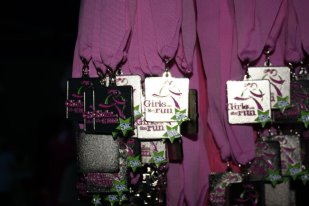
I love to see the hanger full of medals strung from our tent, each one waiting to be hung around girls’ necks. This season, we arranged the hanger weeks before the event, just so we could look at it.
The medals swayed in the back of the car, streams of blue and pink, and jangled as we drove. When we hit the cement wall, the medals flew off the hanger in every direction and crumpled on the floor.
I picked up all I could find and held them in a ragged mound on my lap as Chris drove us to the park. There was no more order, only wrinkled or dirty ribbons speckled with broken glass. I carried them in my arms, a mangled heap, to our set-up site, still a bit dazed, wondering how to recreate order out of what had become chaos.
It was then I was reminded of Erica. I put the medals down and stepped away. Dozens of others stepped in and did what they were there to do. The tent and tables went up, gear was organized and distributed, girls and buddies signed in, medals re-hung. There was smiling, laughter, nervous anticipation. Clouds of pink hairspray.
And then, girls running. Not alone, but with their buddies.
At the finish line, I watched coaches drape a medal around each girl’s neck, followed quickly by a hug big enough to enclose us all.
Read Full Post | Make a Comment ( 2 so far )Thank God for Spectators
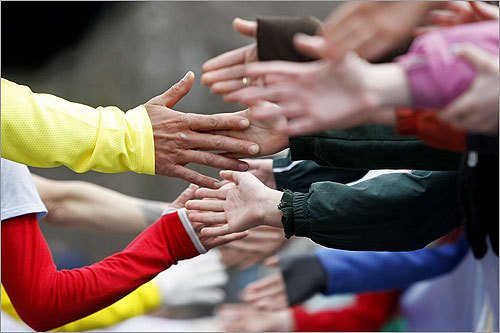
I passed the family twice. A little boy sitting in the yard with his parents, watching runners file by. His dad held a cup of coffee. All three clapped periodically, yelled words of encouragement.
Last Saturday’s 10K was a double 5K loop through a hilly neighborhood. This family was just one of many to spend their morning rooting for strangers. The second time around, I looked for them. I was hot and needed support. When I saw the little boy, I ran faster, glad he was there.
Two days later, I thought of them again when I heard about the horrendous bombing of the Boston Marathon. Like many this week, I’ve struggled to make sense of it. I can’t.
I have tried to imagine what it was like from the perspective of the runners, the spectators. Any way I come at it, I am baffled, to say the least.
I have never been a race spectator. I come to races to run, to compete, to enjoy the course, the day. In almost every event I’ve entered, at some point as I’m passing spectators I’ve wondered, what are they doing here?
A running event is not like most other spectator events. There’s not a lot of action to follow, no rules to figure out, not even a separate, designated space for the athletes to compete. Sure there’s a course, but it’s not for runners only. Anyone can jump in at any time and run with a friend or a stranger, cheer that person on.
(And thank God for that.)
Running is a relatively simple sport. You go from over here to over there and, in some events, it’s really far. So what’s there to see?
People line the streets in a race and practice random acts of kindness—passing out orange slices, hosing down runners when it’s hot, cheering on complete strangers—because they are inspired by what runners do. They come out to see the face of endurance.
Running may be a simple sport, but it’s one that requires a tremendous amount of determination. Perseverance. Sometimes, a sheer act of the will to push the body places you did not think it could go. It’s a sport that is simultaneously solitary and sociable. Every runner is alone with her own mind and body, yet leans on the community that has gathered to help push her along.
Spectators at a race can get close enough to every single competitor to look endurance right in the eye. They get to witness people reaching a difficult goal, one that takes time, hard work, and self-discipline to achieve. How could that not be inspiring?
As it is for the runners who see and hear complete strangers yelling for them. Their energy is like a magnet, pulling you ahead faster and stronger than you would be if they were not there.
Who are these people? They show up in the heat or the cold, stand around for hours on end, lose their voice from yelling encouragement. The people who show up for races are the people who show up for you in life. You know that you can count on them to see you through darkness and pain, or happiness and light. They will be there, urging you along.
Tomorrow Girls on the Run of Bexar County will hold our end-of-the-season 5K. There will likely be more spectators than girls. We get to witness their determination and see it blossom into confidence when they cross the finish line.
I suspect some of them will be running for those who could not finish the race in Boston. All of them will run, buoyed along by the people who will line the way and not let even one of them fall.
So we join the community of runners in our determination to support each other, and to run.
Read Full Post | Make a Comment ( 1 so far )Are You a Loner or a Leaner?

If I fall, I will crush them.
I looked at the circle of girls the head coach assigned me to. Group A. Fitting. There were only 5 of them but they each had an idea of how this game should proceed, and none were reluctant to share.
The day’s Girls on the Run lesson was about community. What it is, how it works, the character traits of those involved in one that is cohesive. The game that introduces the lesson involves trust, a key component in working toward a common goal. We must trust each other if we are to succeed.
Trust. A necessary trait in any community, including the community of runners, though not one I had thought too much about in connection with running.
I have always been a loner, especially as a runner. Running is my time to think, meditate, pray. I need the solitude to plan, dream, vent. As a writer, I need it perhaps most of all—I run rather than sleep on ideas.
The concept of a running community—friends to run with or to make while running—is new to me. Until recently, I had not considered that a running buddy could be fun, beneficial, even necessary. Rather than relying on my own determination or perseverance, enlisting a running buddy—becoming part of a community—would require that I learn to depend on others, that I learn to lean.
Leaning is an integral part of the game that began that day’s lesson. The object is to demonstrate not only that we can be trusted, but that we can trust others. It requires a kind of letting go.
Naturally, I thought, the girls can trust me. Physically I top them by nearly half a person. Their foreheads brush my triceps at best. I would not let them fall.
Nevertheless, as each girl had her turn at trust, one was reluctant to play. My heart wrenched as she stepped back from the circle, setting herself apart. But she had to go, the girls insisted. She was part of their team.
Afraid to close her eyes and let go, she held her body stiff rather than pliable, insisted on control rather than vulnerability. We convinced her to stay with it long enough to relax, let go. Gradually, her muscles released and her eyes closed. The rest of us smiled as we worked together to keep her safe in the circle.
It was a good game, I thought, beginning to break from the circle, happy for the girls’ experience. But wait, the girls squealed, what about you?
I stepped back from the circle, shaking my head.
Don’t you trust us?
If I fall, I thought as I gazed down at the tops of their heads, I will crush you.
Don’t worry, they said. We’ve got you.
So I leaned.
Read Full Post | Make a Comment ( 3 so far )Oh, to Run and Change the World

What would you say to someone who told you that running could change the world? Would you think they were odd, crazy, dreaming? Not my world, you might think. Not the real world, where businesses and people work hard to make a living, get ahead. Running, you might say, is a hobby for most, a pastime, an amateur sport. It might be fun, might get or keep you healthy, but surely it couldn’t change the world.
I had the privilege this week of attending the 10th annual Girls on the Run International Summit, a conference, for lack of a better word, though it was like no conference I’ve attended. It may have had all the trappings of your average conference—speakers, general and breakout sessions, meals and parties—but this conference was distinctly different. What made it so was not the agenda, it’s the organization—the men and women who are Girls on the Run.
Every organization composes a Vision, a Mission, a set of Core Values it displays for all its stakeholders to see. Most include words like customer-oriented, integrity, honesty, excellence.
What about words like positivity, gratitude, empowerment, responsibility. Empathy, joy, love. And more telling than words, what about actions? Could a business be built on a foundation that includes empathy, joy, and love?
When Girls on the Run started, it was led by one woman who brought together one team of thirteen young girls to instill in them confidence, joy, self-respect, to show them their own strength and where it could lead them. Sixteen years later, Girls on the Run is led by 55,000+ women and men across the nation in 208 councils, revealing to tens of thousands of girls their full potential.
Girls in the program learn to be authentic, strong, honest. To respect themselves and others, to make healthy life choices, to be empathetic. These girls will grow up to be leaders in business, education, government. They are learning to lead with love.
The tool that does this? Running.
Sound corny? Far from it. It’s quite real, and part of a movement to bring empathy, responsibility to bear on our actions, in business, education, government.
Who said that running couldn’t change the world? It already has.
Read Full Post | Make a Comment ( 2 so far )On the Cusp of the No Plan Plan

At this time last year, I had a plan. Not just any old plan, but a Master Plan. I wrote out my vision of where I wanted to be in a year and then laid out corresponding goals, each month for a quarter, then six months, a year. I posted both documents, Visions and Goals, on my bathroom mirror so I would be reminded daily of what I needed to do, where to go.
By April I found that I had met maybe 1/3 of my goals. My Master Plan wasn’t so masterful after all, it seemed. The documents came off the mirror as I thought of Woody Allen’s line, “If you want to make God laugh, tell him your plans.” Nevertheless, my visions and goals were embedded in my brain.
Now, at the end of the year, I find that I have met many of these goals, even if I didn’t meet them in (my) time. The goals I missed have more to do with focus than desire. A fortune fished out of a cookie sometime this year waves from my fridge to remind me: The most powerful element in the world is a focused mind.
But it’s almost December 31 again and I have no Master Plan, no vision, no list of goals to post on my bathroom mirror.
This realization set in yesterday when for the first time in a month I stood completely alone in my house, in silence. Last December I had the luxury of time for reflection and planning. This December, by contrast, has been a whirlwind of incidents and events, from beach time and the joy of season’s end to family illness, unexpected home repairs, the stress of season’s end, and the preparation required to begin a new season.
Oh yeah, and then there was Christmas.
For some reason, I’m not so worried about not having a plan. December 31 isn’t the official Master Plan Deadline and, as far as I know, I won’t melt if midnight strikes and I’m on the No Plan Plan. There will be enough time.
Among the many lessons I learned this year, two apparently contradictory principles stand out:
- I seem to be happiest when I forget about myself.
- We receive in life what we think we deserve.
I’m not exactly sure how my Master Plan will take shape, but I know I need to begin here.
Fortunately, as I begin to think about 2013’s visions and goals, I am not completely planless. My training plan is still tacked up on my fridge, guiding me toward that half marathon in February.
At least there is this: I plan to run.
Have a blessed New Year.
Read Full Post | Make a Comment ( None so far )The Best Effort

Last Saturday, Girls on the Run of Bexar County held our end-of-the-season 5K. 104 girls, their running buddies, and friends and families showed up to complete this event, the goal the girls had been working toward for 10 weeks.
Even though we’re called Girls on the Run, we’re not exactly a running program. That is, our goal is not to teach girls how to run, although that certainly is part of what we do. Rather, our goal is to teach girls how to make healthy life choices, to set and reach goals, to respect themselves and others, to be confident. Running is the tool we use to do this, an incredible tool that yields incredible results.
For this race, rather than handing out 72 or so medals to the top three places, male and female, all age groups, we decided to give out only 6: Top 3 male and top 3 female. We weren’t concerned about how the girls placed. We’ve impressed upon them throughout the season that the point of the 5K was finishing, not winning. The fact that they showed up to the 5K meant that for 10 weeks they’d been giving it their all and were already winners. All that was left for them to do on race day was to cross the finish line. Time didn’t matter. Their best effort did.
The crowd gathered at the finish line to cheer the girls on as they approached, faces glistening, smiles wide. The first several finshers were men, the overall winner a retired colonel and cancer survivor. The next two were first-time 5K runners who looked just as overjoyed as the girls did when they crossed the line.
After a few minutes, we saw the first group of girls coming up over the final hill.
What we saw from our vantage point was this. Four girls ran hard, while their running buddies hung back, encouraging them to run. The four girls sprinted through the line, first and second place nose to nose, third and fourth a few steps behind, also nose to nose. First and second place were winded and flushed and smiling hard. Later, they beamed when I placed the medals around their necks.
What I discovered later, from a different vantage point, was this. The first two girls were in the program, completing the fall season. The third was an alumnus, who’d been in the program twice and was running with a friend. They all ran hard throughout the race, giving it their best, but as they neared the end, the alumnus and her friend found themselves gaining on the top two runners.
They could have passed them. Part of them really wanted to. But as they came up that final hill, they realized how important it might be to the two girls in front of them to cross the line first. They looked at each other, nodded, and slowed down their pace, just a hair.
They crossed third and fourth, winded and flushed and smiling hard. Time didn’t matter. Their best effort did. We couldn’t be more proud.
Or so we thought, until we saw the face of the 104th girl, who danced across the finish line, smiling all the way.
Confidence. Joy. The most beautiful medals to own. 104 of them last week. How can you beat that?
Read Full Post | Make a Comment ( 1 so far )Confessions of a Lone Runner
I have always said that I prefer to run alone, before dawn. Running alone gives me clarity, helps me focus on my life, my day, whatever issue ails me. It opens my eyes to all I am grateful for, including the stars and sunrise and empty streets.
But I’m sure I run alone out of habit more than preference. I have always been a loner. We are creatures of habit, after all, and a loner gets used to being alone.
Strange, then, that I would end up here, director of an organization that empowers girls through running, that seeks to show girls through experience that they are the arbiters of their own lives and can do anything. Yet they need not do it alone. They are, rather, an essential part of a team—an entire community—and without their contribution the world is much less.
Girls on the Run, this fantastic organization I am blessed to be a part of, has the power to transform lives, not only girls’ lives, but the lives of the remarkable (mostly) women who support it. The organization cannot exist without the network of coaches and other volunteers who weave it together into a strong, beautiful, and resilient web that refuses to let girls fall.
Strange, then, that my task—the loner—at this moment in life is to connect the lives of these women and girls, to support them in their effort to build relationships and teams, to strengthen character, to grow.
Tomorrow is our season’s-end 5K. Over 100 girls will run this race with running buddies at their sides, families and friends cheering them on. When they cross the finish line, they will have gained the knowledge that they can do what they put their minds to. They will establish confidence through accomplishment. It is our hope that this confidence carries over into other areas of their lives and teaches them what it feels like to finish what they started—and that they are not alone in doing so.
This morning I ran alone, before dawn, anticipating tomorrow’s event, mentally juggling all the balls still in the air that won’t land until the race is over and the grounds cleaned up. I often think on these runs that we are placed in life not only where we can do the most good for others, but where others can do the most good for us too. A loner gets used to being alone and strives for independence, not asking for help. Never expecting it. Not understanding that interdependence is a much worthier goal.
Strange that on this morning’s run I didn’t feel alone.
Read Full Post | Make a Comment ( None so far )What Running Could Teach a Girl
I want to show girls how running teaches them things that can change their lives.
I hear that sentiment a lot as I talk with women who want to become coaches or other volunteers for Girls on the Run. I smile every time because I understand just what they mean. Now.
There was a time, however, when hearing such a thing struck me as completely ridiculous. How could running teach a person about life? All it seemed to teach people was how to sweat a lot and injure muscles and ligaments I had never heard of. How does limping through life with wet socks and undergarments teach anyone anything useful about living? Sheer craziness, I thought.
Until I ran. Now, I am a runner.
Did you notice the way I phrased that? I am a runner. I did not say that I became a runner, or that I learned to run, although both statements are true. Instead, I chose a phrase that defines a present, permanent, pervasive state of being. You could almost call it an inhabitation. Now, it is quite natural for me to say this: I am a runner. For a long time, it was not.
I often think about why that is the case. People frequently ask me if I am a runner, and it always startles me. For some reason, I don’t expect it to show. I know that many runners have identifiable physiques, as do jockeys and sumo wrestlers, but I don’t think it’s the association with a particular body type that surprises me.
Maybe it’s because for me running is not about the body anymore. It’s about the soul. And to ask if I’m a runner means that in some strange way the most private part of me has been made public. A clearly unsettling prospect for anyone. Unsettling, and life changing.
Running didn’t show me that I had a soul (I’d like to believe it was already there), it made me understand that what I needed to succeed in this life—what I needed to make healthy and loving choices, to be strong and confident and at peace—was already there inside me. Running helped me to tap into it and pull it out, unfold it and put its pieces together, like the kite you might get in your Easter basket, ultimately billowing high above the earth but tethered to you by a string.
And that’s what these volunteers want the girls to see. That they already have at least the pieces of everything they need to live a happy, healthy life right there inside them.
If they can get the girls to take just one step, to move forward just a little, the girls will learn to trust the voice they hear inside when they run. Eventually, the girls will run into themselves.
And maybe some of them will one day say, I am a runner.
Read Full Post | Make a Comment ( None so far )Who’s the Chick with the Legs?
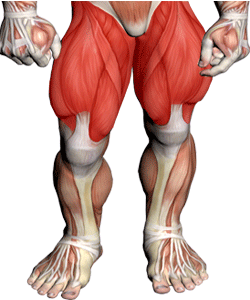
That’s the question a group of women asked after our last Girls on the Run 5K. That chick is certainly not me. It’s my sister.
Marika has the hardest—but the best—responsibility at our 5K events. She’s the course monitor. It is her task to run the course in circles, ensuring that each girl sticks with her running buddy. When Marika encounters a girl running on her own, she asks where her running buddy is. If the girl points behind her and says, somewhere back there in the dust, Marika pairs her up with the nearest buddy team keeping the girl’s pace. If the girl is alone because she’s too tired and discouraged and ready to quit, my sister encourages her along, refusing to let her stop. For the last half of the race Marika runs the quarter mile before the finish line, back and forth and back again, like a pinball ricocheting between two levers, guiding every girl and her running buddy to the finish line. I have seen her take a number of girls by the arm or around the waist and virtually carry them just short of the line, where they cross on their own.
I have seen her do this—and more—because I have the second best responsibility at the race. I get to stand on the other side of the finish line and help the coaches put medals around the girls’ necks as they finish the race. Think you can’t run or that there’s not much rewarding about doing a 5K? Check out your local Girls on the Run council’s next 5K. I can almost guarantee you’ll walk away completely uplifted and probably in tears.
But I digress. We were talking about my sister’s legs. My sister is assigned the hardest job—running in a very short time more than double the 5K—because she has the strongest legs. I wish you could see for yourself, but Marika is modest and refused me permission to post her picture. What you would see is quads like braided bread. Something like this:

Well, maybe not quite like this, but you get the picture. Marika didn’t get those quads from running. She has been running for almost 3 years. I have been running for 10. For years, I tried to get her take up running, but for years she refused. Each time I brought it up, she pulled out her arsenal of studies demonstrating the damage running does to the body, particularly cartilage and joints.
Marika chose, rather, to strength train, and has been doing so consistently for 5 years, intermittently for maybe 3 years before that. For years, she tried to get me to take up strength training, but for years I refused. I wanted to focus on running—what did I need muscles for? My leg muscles would be just fine, thank you very much, from the workout I gave them on each day’s run.
Or so I thought.
When Marika finally took up running in 2009, she did so for much the same reason I did. She was trying to work out a problem and needed fresh air to help her think, so she went out walking. Some issues are too big to be confined by four walls and a ceiling, and they need a large expanse of sky and open space to be properly taken out and turned over, mulled through and examined.
It was during one of her walks at dusk in the late fall that she was caught in the rain about two miles from home. It wasn’t a nice Texas mizzling kind of rain, part drizzle, part mist. It was a cold, pelting, stinging rain that she wanted to escape. The quickest way to get home was to run. Somewhere in that two miles, something clicked.
Two weeks after Marika ran, I was set to participate in a half marathon, for which I had been training. She thought she’d give it a try too. She had been running for only two weeks, mind you, before she entered this half marathon.
She beat my time by 5 minutes. I couldn’t decide if I was awed or ticked.
(What’s the difference between friendly non-competitiveness, healthy competitiveness, and the urge to pummel someone to the ground? I don’t know either, but I’m working on it. When I figure it out, I’ll write about it.)
Granted, Marika has a strong cardiovascular system. There is no way she would have been able to complete a half marathon without one. But I am convinced that her strength drove her along. She has been running ever since—and running fast.
But that’s not all. I finally convinced her to enter a sprint tri with me. We trained together for 8 weeks to compete in the Gator Bait race just last month. She whined the whole time we trained. Although she had a bike, she hadn’t actually been on it in a couple of years and couldn’t remember how to shift gears. The first two times out, she wiped out and scraped her knees and, we think, broke a bone in her hand. Swimming was even worse. Although we had grown up on water, Marika had never swam laps in a pool. Half way through a lap, she was sputtering for air.
Don’t worry, I told her, I’ll teach you everything I know about biking and swimming. It might not be much, but it will get you through the race. Do it for fun. This is only about fun, not really competing, and not winning, but only to see if you can.
I knew I was in trouble on our fifth or sixth bike ride when she powered past me up a hill. I could see her quads pumping like a freight train, while I was wheezing my way up. She barely broke a sweat.
And then she did it again. Come tri day, she beat me. By 7 minutes.
(How do I feel about this? See the above parenthetical.)
I tell you about my sister and her legs and her accomplishments to make a point. Probably several points, but here’s the one I’m sticking with: Strength training is imperative to performance. It doesn’t matter how much cardio you do, how many miles you run or swim or bike, your muscles must be in prime shape in order to serve you to the best of your ability.
Strength training is important for so many other reasons—including preventing bone loss, especially in women, as you age. But I won’t go into all that now. I simply wanted to tell you about my sister.
And what she’s done to my training. Since the sprint tri, my focus has not been on cardio or mileage, but on strength training. I’m in the gym at least three days a week now, and it’s paying off. Last weekend I went for a long bike ride and found that the monster hill at the end of my route is getting easier. Maybe one day soon I’ll be able to power up it myself, and pass my sister.
Read Full Post | Make a Comment ( 4 so far )« Previous Entries Next Entries »
 More Than Running...