Dodging Hurdles, or the impetus to run
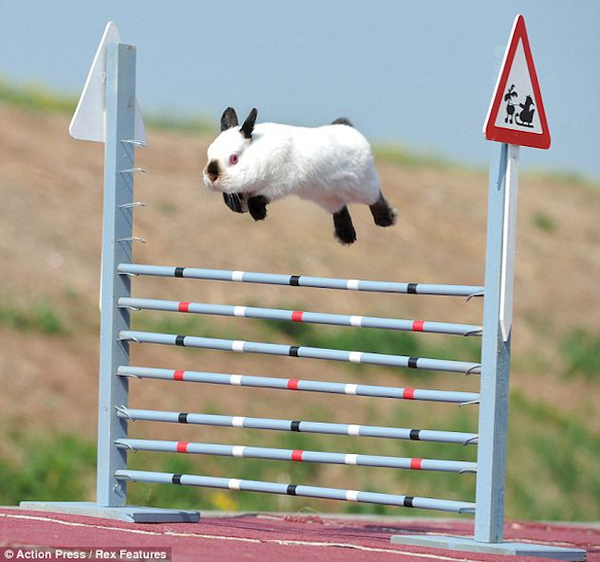
image from cutestlife.com
The first time I took up running it was because of a boy. A crush. I was starting junior high, seventh grade, and he was a year ahead of me. Naturally wavy blonde hair. Blue eyes. Athletic. I was tall and had long legs, and he suggested I try out for the track team. So I gave it a go.
The first day of try-outs, the coach looked at me, my height, the length of my legs and said, “You’re running hurdles.”
Hurdles? You mean my feet have to leave the ground and I need to open my body like a jackknife over that thing that looks like a traffic barricade?
The eighth grade boy nodded vigorously. I gave it a go.
“How about the high jump?” the coach suggested as she picked gravel out of my bloody knees. My body was not built to open like a jackknife. It preferred a straight line. If I could simply run and weave around the hurdles, straight flat-out running, maybe it would be all right.
I kept a brave face, even though my knees stung and the skin hung from them in tiny flecks like shredded cheese.
But the eighth grade boy nodded vigorously. So I gave the high jump a go.
On the first try, I sailed over the horizontal bar. Never mind that it was less than two feet off the ground and I could have hopped it on one foot. The coach clapped her hands and raised the bar twice as high, level with my waist.
I stepped back to the start line, sweating, and eye-balled the bar. Surely I could do this. The eighth grade boy was watching, as was the coach, my friends.
I ran toward the bar, planted my foot at the base, and sprung into the air, landing on my butt in the sand trap on the other side. I heard a sound like a bell clanging, and my forehead stung briefly. I blinked sand out of my eyes, pleased that I had made it, for the split second I thought I’d made it, and tried to stand up.
But all eyes were on me, and all mouths were open.
“What?” I said, but before I could say more, my eyes were forced shut. Blood poured down the right side of my face, into my eyes and the corner of my mouth.
I yelped as my hand flew up, swiping at the blood. I looked toward the bar, but it was not held aloft on the pegs. My foot had hit it, dragging down the support poles, one of which knocked me in the head.
I sat on the curb in front of the school alone and waited for my mom. Several stitches and a concussion later, I decided that running was not for me. And maybe neither was this eighth grade boy.
It would be twenty years until I took up running again. The second time, I took it up because of me.
There would be no one to impress. No one to determine my ability based on my appearance.
No one to tell me how far I could go or how fast, or to place obstacles in my path.
There would be only the long-fingered mango leaves beckoning me down the road in the star-soaked, pre-dawn darkness of Guam.
This time, I more than gave it a go. This time, it stayed.
Read Full Post | Make a Comment ( None so far )Creating Order out of Chaos
My new training plan is posted on the side of my refrigerator, a black and white grid containing daily directives and empty white space awaiting my penciled-in results. I love a new plan. It’s challenge and promise weigh equally. It gives me a sense of purpose each day. A reason to get out of bed earlier than the birds. And the direction and clarity to know what to do even after the white space is filled in.
That’s the key, really. The “after” part of completing the daily plan.
Sure, running is the reason for the plan. And, for now, for my new 16-week plan, biking and swimming is too. It is the reward, the goal, the tool, the end in itself and the means to a greater end all rolled into one. There is freedom in running. There is joy and health and confidence.
But there is more.
Running helps me to create order out of chaos. And chaos is, after all, life, mostly.
It is a million different forces all pressing on us at once, vying for our attention, demanding action. It is a million bits of information clamoring to be heard, absorbed, incorporated into the design.
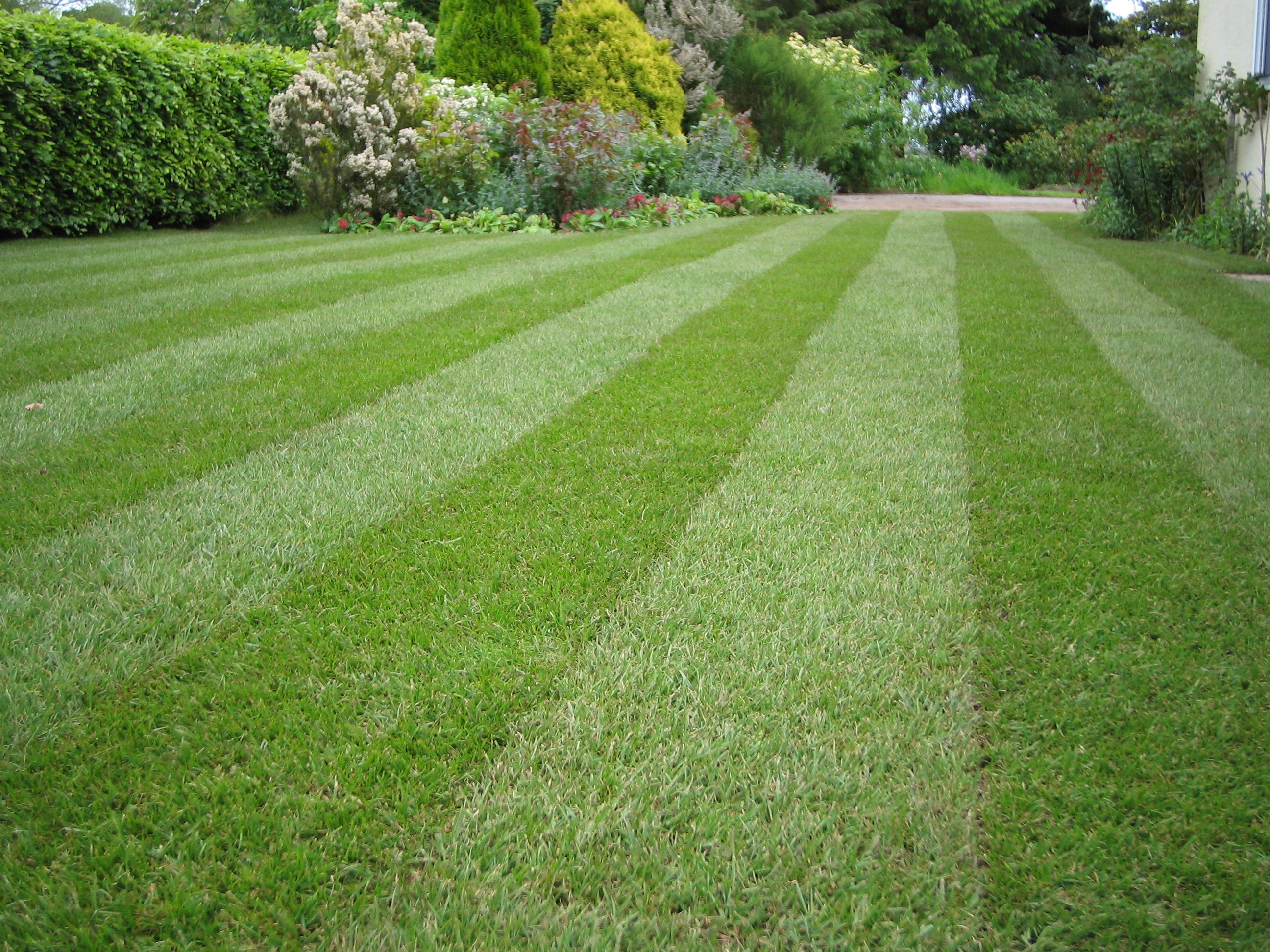
It is a million blades of grass forming a raggedly blanket of a lawn that the HOA insists must be flattened and smoothed.
I get tremendous satisfaction in mowing my lawn. Watching straight lines form in the grass behind my mower, leaving a wake of structure.
So it is with me in running. The sheer act of physical movement, of allowing my mind the freedom to construct my day, week, month, story, life at the dawn of each day produces the structure for all else. Without it, I cannot write, at least not well. Without it, the organization I lead would not be led strategically, compassionately, or wisely, a goal I mindfully set each day, but instead would become like the field behind my house, overgrown with weeds.
My desk has always faced a wall. Until recently, the wall has been blank. Now, a corkboard hangs in front of me, the center space empty, all else tacked to the sides. Whenever I look up, I see the vision of what will be that my mind’s eye projects there, like a movie on a screen, the endless possibilities a swirl of chaos. Writing and leading an organization have this in common: You must always keep your vision in front of you to make the right choices, choose the right ideas, to create order out of the chaos.
My new training plan started this week. The Royal Empress and Mountain Laurel have just begun to bloom. Their fragrance rolls out before me like a red carpet when I run. There is so much promise in the newness of spring, its plan unfolding.
Read Full Post | Make a Comment ( None so far )Flat Tires
I’ve seen this commercial several times. We see the face of a young woman as she changes her tire in the rain. She appears anguished, there in the rain alone. We are distressed too. Is she safe? Will anyone stop to help her? The camera pans out to a man standing next to the car.
Appearances can be deceiving.
“I told you you could do it,” the man says. The girl, obviously his daughter, smiles confidently in her newfound ability as the rain stops and they get into the car together.
I generally hate commercials, and I particularly hate car commercials. But I love this commercial. I love that this father empowers his daughter, showing her that she need not rely on others to do things for her unless she wants to. She can do what she puts her mind to.
I was lucky enough to have a dad like this too. He believed in doing things himself whenever he could. This is the man who built most of his home’s second story by himself on weekends, vacations. The man who always mowed his own lawn, planted his own flowers, painted the house, the deck, the awnings, the lawn furniture.
Sometimes do-it-yourself worked out fine. The second story carpeting looked fantastic, for instance. Other times, calling in a professional might have been a better idea. But who needs a level driveway anyway? He was a firm believer in trying.
So when my first car needed an oil change, he took me to the gas station and showed me how to find the right oil and filter, then dragged me under the car to finish the job. When my headlight went out, I fixed it, with my dad standing behind me. It didn’t feel so empowering, then. It felt greasy. Dead-buggy. And I felt awkward doing something I wasn’t used to.
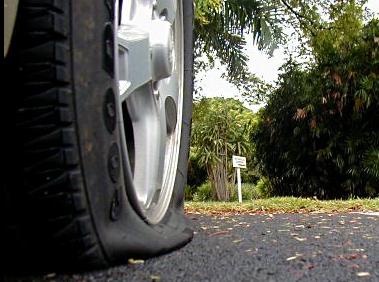
A few years ago, I had my first flat tire. I had never changed a flat with my dad, but I had seen one changed. This tire wasn’t just flat, but blown right the heck out. My fault. I was new to Texas, not used to the razor-sharp markers sometimes used to separate traffic lanes, and I ran right over a whole stretch of them. The mechanic who later attempted to fix the tire asked if someone had slashed it with a machete.
I pulled over and sat in my car for a few minutes, hoping someone would stop. I knew what to do, in theory, but I felt awkward doing it. What if I screwed it up somehow or made it worse? What if I accidentally fell over into oncoming traffic when I tried to remove the tire?
But no one stopped. I got out of the car, more irritated that I was going to be late than that I had to change my tire. I hate being late. I unloaded the spare and parts from my trunk and watched the road with one eye.
A handful of cars drove by. No one stopped.
I jacked up the car, swearing as I dirtied my shirt looking under the car for the groove to place the jack in, and started to loosen lug nuts. Not an easy task, let me tell you. I stomped on the tire iron and could barely budge them, at first.
More cars drove by. Still, no one stopped.
Finally, I got the tire off. A semi pulled over a couple hundred feet up the road.
“Hold on,” the driver yelled as he walked my way. “Let me finish that.”
I waited for him to get there, then thanked him for stopping to help.
“I wasn’t going to,” he said. “I mean, you look like you know what you’re doing. But then I thought of my sister. If she had a flat, I’d want someone to stop and help her.”
I wasn’t sure what to make of this. How odd that I look like I know what I’m doing, I thought. Sure, I know the process, but I am not at all comfortable actually completing it.
“Do you think that’s why no one else stopped?” I asked him. “Because I look like I know what I’m doing?”
“I guess so,” he shrugged and turned his attention to the tire.
I crouched into a deep squat and hugged my knees as I watched him finish changing the tire, grateful that I did know what to do. And grateful that he did too.
Read Full Post | Make a Comment ( 2 so far )What Would You Give?

For years I have not observed Lent. At first because I dropped out of the church, and then later, when I dribbled back in, because I got tired of seeing Lent trivialized. It’s not the latest diet, the Lenten 15, say, a plan to drop those last stubborn pounds in anticipation of swimsuit season. And it’s not an excuse to cut out meat on Fridays, only to show up at your local fish monger and indulge in lobster.
I, of course, have done these things in the name of Lent. Deprived myself of chocolate and Fritos or wine and beer in an effort to reach an objective that was personal and selfish, not communal and considerate of others. I have established my goal, created my plan, and expected my God to follow along granting my desire. Like Aladdin’s genie, but maybe not so blue.
I have thought that if I could demonstrate to God my ability to deprive myself of certain things, then He would reward me. With what, I wasn’t sure. Nice things, a great job. Happiness, maybe. A medal.
I have even made running my idol, expecting God to affix wings to my heels.
But, as Woody Allen asserts, if you want to make God laugh, just tell him your plans.
What I’m figuring out, I think, is to focus not on the goal or the plan but, rather, on the gift, the ability God has given me. Like writing. Compassion and empathy. Mercy. And even running. And to remember that these gifts are not mine to keep. Gifts are meant to be given.
So the question I face this Lenten season is not what do I deprive myself of. Not exactly. I know that I can be self-disciplined. But what do I give of myself. What can I offer to others so they can be happier, better, stronger? How can I bring someone joy or compassion or love? Consciously and deliberately. Not accidentally or incidentally.
It’s Ash Wednesday today, the day I write this, and I’m still not sure how to observe Lent. A funny word, “observe.” Implying that we will hang around and passively watch something happen rather than actively participate. But action is required. It is the end of reflection.
And, I think, it’s never too late to pare ourselves down to the bone, to become less in order to give more.
Read Full Post | Make a Comment ( None so far )Juggling Oranges

Tuesday was one of those days I wondered why I do what I do for a living. Why, exactly, am I here? Nothing was going as planned. The day was supposed to be devoted to grant writing. A deadline is coming too quickly. Just a matter of days.
The disruption started at 5:42am with one crisis and then continued until well past 7:00pm. It’s always the small things that get you, and the immediacy they demand. A coaching situation to resolve right now, a shortage of supplies at three sites to be remedied today, a promise to 18 girls that must be kept.
The confusion in time zones that causes you to miss a call you’ve had scheduled for two weeks.
And then the big things: Remember that conference on Thursday? Guess what? You get to deliver a piece of it. Start preparing. Oh, and, to help, our team will have a one and a half hour conference call this afternoon.
Timing is everything. How to participate in a conference call while driving to three sites and take adequate notes while running supplies into buildings? We are on point number two in the call, two points away from my piece. Surely I have time to sprint up to the school with 15 pounds of oranges, drop them where they belong, and sprint back to my car with my phone on mute before they ask me for my input? Barely. But I try. I can still answer questions out of breath, car door slamming, engine starting before I break three laws and drive in a school zone with my phone on speaker, resting on my knee.
But I am irritated. Anxious. There is too much to do and not enough time. I hear my other line ringing and messages piling up. Hear texts chiming, emails accumulating. My eye is on the clock and I’m thinking about the grant and remembering the other phone calls I was to have made today. An office day, it was supposed to be, an administrative day. A day to write that grant.
As I sprint two blocks from my car to the last school, up two flights of steps, and down the hall juggling another 15 pounds of oranges and my phone, muted conference call still going at my ear, I see her come out of the bathroom.
I don’t know her name, but I know her, this little girl. We met last week when I subbed for her team. She is shy, chubby. Tilts her head down and smiles bashfully when she sees me. She is wearing a chain around her neck, the chain she got in Girls on the Run to collect little sparkly feet on. One foot equals one mile. The girls accumulate feet all season as they accumulate miles.
One sparkly foot dangles from her chain. Last week, her teammates each got at least two feet. One girl earned four.
She stops walking and stands there quietly in the hall, rocking a little from side to side.
I know this girl. Shy, chubby, not athletic, wanting to speak but too timid to do so. Waiting patiently just the same. She is me when I was 9, 10.
I take the phone away from my ear.
“You’re wearing your foot,” I say.
She nods slowly, smile broadening, and raises her hand to her chain.
I nod back. “Think you’ll get another today?”
She nods again, a look of determination deepening her smile, and clutches her foot.
“I think so too,” I say.
She raises her chin just a little and walks proudly back to her classroom.
“Hey?” I hear someone say my name and I remember my call. “Are you there?”
“Yes, I’m here,” I take the phone off mute and watch the girl walk down the hall. Now I remember why I’m here.
Read Full Post | Make a Comment ( None so far )Do You Recognize Improvement When You See It?

Two weeks ago, I stood at the bottom of Temple Hill, the steep half-mile hill with the false top three quarters of the way up, my hill-repeat nemesis, and stared up. It was cold that day. Windy. But it was the last day for hill repeats in this round of training, for this particular half marathon, and Carrie and I had just finished our series of repeats. I wanted to mark the hill in my head. Remember the grade, the cold and wind, the burning that did not transpire in my lungs or quads. Not this time. We had improved.
Improvement can be such an elusive thing. Often not because it doesn’t happen, but because it can be so slight it’s almost imperceptible. If we don’t pay attention, we miss it.
Take, for instance, this hill. We were finished and walking back to our cars before we realized some small things.
- We did five hills—and chatted up and down the entire time. Previous training days were silent affairs, the loudest and most extended sound often the gasping for breath.
- Once we reached the top, we turned around and ran down. Not so on earlier runs. We breathed too hard, then, and had to walk a good quarter of the way down until we could even begin to run.
- And once we hit bottom we turned right around again to run back up, no down time in between. On earlier runs, I would have preferred to camp out at the bottom for awhile. Build a fire, maybe. Roast some marshmallows. But there was no need to this time. We had improved. And we almost missed it.
Did it make a difference on race day? Training always does. We ran the Austin Half Marathon, the hardest course in my half marathon experience so far because of all the hills.
We finished the race knowing we ran well and could not have done anything different. That’s the best feeling after a race. When you’ve given it your all.
And the second best feeling is knowing that your all is an improvement. Carrie PRed. I ran my second fastest half marathon time. It’s the small things that matter. Put enough of them together and you get something big.
Read Full Post | Make a Comment ( 1 so far )Like Mother…and liking it

No wonder I’m a runner. Just look at my mom. No, she’s not a runner. I have, in fact, no memory of seeing her run anytime, anywhere, in my entire life, ever. No. She’s decidedly not a runner.
She’s a shooter, and a darn good one. This year, she will be inducted into the National Skeet Shooting Association Hall of Fame. Quite an accomplishment, and one I am profoundly proud of her for.
You’d think with a mother possessing that kind of ability I’d become a shooter myself. Not a chance. I was never patient enough to shoot well. Plus, the whole thing seemed so involved. Too much equipment—and then you have to clean it. Too much effort to go somewhere other than out my front door to practice. No thanks. Not for me.
For a long time, I didn’t quite understand her obsession—for lack of a better word—with skeet. It wasn’t until I took up running in my early 30s that I began to understand how a person could spend so much time and so much effort doing something that seemed so, well, frankly so insignificant.
But my mom’s obsession is not with obliterating little orange targets. As mine is not with becoming perpetually faster. Medals aren’t the goal for either of us. Becoming a better person is.
In the past several years, I’ve come to see several parallels between running—a pursuit that requires no other equipment than a pair of shoes, can be practiced anywhere at any time, and can result in a conditioned body—and skeet shooting—an endeavor that requires expensive equipment and accessories, must be practiced at a specific venue, and rarely produces an increased heart rate.
Every time we step onto the playing field, we’re competing primarily against ourselves. Sure, it might be nice to actually win something, but becoming good enough to win consistently takes time. Hours and hours of time. Dedication. Persistence.
The goal I want to achieve at almost every event is to do better than I did the last time. Sometimes, my goal is simply to finish, uninjured. But I’m my own biggest rival. My most enthusiastic cheerleader and my worst enemy. Yet with competition comes the confidence acquired when reaching a goal as well as the quiet grace and humility attained when giving it everything yet falling short.
So we practice, because practice breeds perseverance. It makes us better, faster, stronger. More accurate, more consistent. This is, of course, true of any sport, but I’ve seen both shooters and runners practice in the absolute worst conditions. I long ago stopped chiding my mom for spending hours outside in the brutal Michigan winters or the searing Texas summers. How can I chide her when I have practiced my own sport in typhoon stage 3 readiness or cold so piercing that icicles formed on my hat, scarf, and mittens?
I realized, during one particularly cold run when I initially could not feel my legs, that we both live a sort of Senecan philosophy: If one prepares for the worst, she will be more likely to do her best when it counts. It is what self-discipline is made of.
Running and skeet shooting both are solitary endeavors. You might be surrounded by people, but most of the competition is meted out in your head. Your success depends largely on what you believe you can do.
But both are team sports too. Your friends are also your competitors. Mostly, they genuinely want to see you succeed. But they also want to succeed themselves. On the field, you are simultaneously together and alone, so deep in your own head that you could very easily lose the connection with the person standing right next to you.
But you don’t. Because you recognize the critical role support plays and how sometimes the difference of just one word of encouragement (or spite) can make or break you.
Ultimately, both sports are a test of character. Ultimately, neither running nor shooting is a game. How you show up in each is how you show up in life. I’ve seen people I thought were kind and compassionate off the playing field turn into mean, puerile creatures on. And I’ve been pleasantly surprised witnessing an act of kindness from a stranger.
At heart, what we are when we compete is who we are as people.
In all these years, my mom’s character has been refined by shooting. She possesses a quiet confidence in her ability yet a humility I sometimes find bewildering. She continually and sincerely roots for the success of strangers as well as friends. And I have never seen a more graceful loser. I am lucky to have her as a role model, a mother, a friend.
No wonder I lead an organization that inspires joy, health, and confidence in young girls. Just look at my mom. That’s what she inspired in me. In fact, she still does.
She took up shooting at a time when women were not allowed to be members at some clubs. At a time when girls didn’t do such things as shoot guns, get dirty, spend time outside in the cold and rain, in spaces dominated by men. Her family, some friends, much of society gasped in disapproval and said, No, you can’t.
With the determination and dignity she’s always possessed, my mother said, Really? Just watch me, and went on to become one of the best.
How many times in my life has that pernicious voice at my ear told me, No, you can’t. Sometimes that voice is my own. Yet there my mother is, standing beside me, in quiet faith insisting, Yes, you can.
Read Full Post | Make a Comment ( 3 so far )Why Change?
Last time I checked, it’s still January. We’re just over halfway through with it and already change is hard. I didn’t make any New Year’s resolutions. Not really. I simply realized (once again) the need to be deliberate, to be present, since the present moment is all we are truly given.
A fortune from a cookie is pinned above my desk to remind me: “A focused mind is one of the most powerful forces in the universe.” I vow to start each day, before I ever get out of bed, focused with a prayer first of thanksgiving for this day, and then for guidance: Wisdom in my decisions, prudence in my actions, compassion in my communication. Then and only then will I allow my mind to be crowded with all there is to be done today.
But, as it turns out, even as small a change as this is hard to make. Just yesterday morning, for instance, my alarm went off at 5. I knew all the things I had to do that day, as I do every day, because I keep a calendar and a to-do list, both of which I review frequently. I planned to get up and run, then write, then work from home for a couple of hours before some afternoon meetings. If I didn’t get up in time, something would have to give. And I knew that something would be either my running or my writing, neither of which I am willing to sacrifice.
I have changed the way I think about both writing and running. I don’t have to do them every day, only some days, and on the days I choose to do them, I do them deliberately. So much pressure removed, so much focus added. Both activities improve tremendously, and so does my attitude about them.
But yesterday morning at the sound of the alarm, rather than starting my day with a prayer, I started with the rapid blur of mental gymnastics as I thought about how to change my day’s already-established plan:
I don’t really have to put in eight miles today I can do it tomorrow because tomorrow I have a running meeting on the Salado Greenway Trail at 11 and we’ll probably run four miles so I can always go early and put in four before or stay later but I can still get up at 5 to get my writing in because if I do run then instead of now that cuts into tomorrow’s writing time and…
It was cold and dark, you see, and I had eaten too many Cheetos the night before. I just wanted to lie in bed a little longer, until my stomach didn’t feel queasy. Or until spring.
And then it hit me. This whole idea of change. Not only that I was bucking against my own self-imposed new system, but that there was another change I needed to make too. I couldn’t go to the trail to run alone. Because that would be stupid. Unsafe. And the one change I felt compelled to make after New Year’s Eve was to not run alone in secluded places. Not since Lauren Bump’s murder.
So I rolled out of bed and got ready to run in a place that may or may not be safer than a trail: my neighborhood. I’ve always thought of my neighborhood as safe, just as I’ve always thought of the trailway as safe. Now, in my mind, they are equal. And now, for the first time in my life, I carry pepper spray. Another change to get used to.
Read Full Post | Make a Comment ( None so far )Processing a Runner’s Murder

On New Year’s Eve day, 24-year-old Lauren Bump pulled into O.P. Schnabel Park on the west side of San Antonio sometime shortly before 3:00 pm. I imagine she stood outside of her car and stretched, leaned her body left and right, arms overhead, lengthening her IT bands. She may have grabbed an ankle, hiked it up behind her, pulled gently, first one side, then the other.
I imagine she found her favorite music on her iPod, stuck her buds in her ears, and took off at a slow and easy pace down the trail, out onto the Salado Greenway. She probably inhaled deeply, looked up into the sky, taking in the sun and birds and tranquility of the trails. It was perfect running weather, mid-50s at 3:00, and she smiled as she settled into her run.
I can imagine all of this because it’s what I would have done had it been me out there running. It’s what I do each morning I go out for a run, gratefully anticipating the peace and time and space. It’s what I need. What keeps me right with myself, with the world.
Only, now, my peace is gone. Not only can I imagine Lauren setting out for her run, I can also imagine—in horrifying detail—how she must have felt, blindsided by a maniac with a knife slicing away her tranquility, her promise. Her life.
Like the rest of San Antonio and the running community here, I am stunned by Lauren’s brutal murder. In broad daylight. In a public and well-used area. I cannot imagine how her family must be reeling at their loss. I cannot imagine how someone could do such a thing.
And I cannot get past my anger. Of all the many things associated with Lauren’s murder—I cannot call it her “death,” as that word seems too passive, implying no agent of action to have caused it—to be angry about, I’m not sure which weighs most heavily.
Perhaps it’s that I feel the need to change my way of life, one that I was happy with on December 30. Maybe it’s that what’s driving the impetus for change is not the desire for self or community improvement, but fear. Nothing angers me more than fear. Usually, its presence makes me want to face its source head-on. But this time, I feel like I can’t, because it’s not a man I’d be facing. Or a tall building or a nest of spiders or den of snakes. Rather, the source of my anger is the knowledge that what happened to Lauren could have happened to anyone of us, any time, any place.
I choose to see the best in people because I like to believe that we all have something good and decent within us, that we are all capable of greatness. I choose to see the promise in humanity.
But all the while, I know there are people out there like the man who murdered Lauren, and I see the flaw in my vision. What do we do with people like him? I don’t have an answer. Do you?
Read Full Post | Make a Comment ( 5 so far )Deliberation

Only that day dawns to which we are awake. There is more day to dawn. The sun is but a morning star.
~ Henry David Thoreau
Going into this New Year, I didn’t have much time to reflect. Usually, I like to spend a few days thinking. Looking backward and forward. Writing things down—a plan, a list, the Hamlet T-square of things to be or not to be. But this time, there simply was no time. Too much work, then too many parties, an abundance of family, and before I knew it, it was New Year’s Eve.
The whole time I wasn’t preparing, I recognized it, and it bothered me. I wanted to look, wanted to reflect. The past year stood before me like a full length mirror, but each time I tried to gaze into it, I was distracted by what was in front of me and couldn’t see in.
On December 30, I stopped worrying. I was talking with a friend about relationships, including our relationship with our self. We both agreed that many people can hardly see themselves as they truly are, may never see themselves as others’ do. My friend meant literally. I meant in every other way.
If we look into a mirror and cannot accurately see our own reflection, then how can we expect to look backward at a year and accurately reflect on ourselves? Our sight is often distorted. We see what we want to see, what we are able to see, what we are prepared to see.
I am thus going into the new year looking forward rather than back, even if 2013 was a good year. More important, I am focusing on—with appreciation, gratitude, joy—where I am today, since today is what I have. And the day has only begun.
Read Full Post | Make a Comment ( None so far )« Previous Entries Next Entries »
 More Than Running...