When Running Isn’t Enough
Running is the only thing I have to look forward to right now.
That’s what a friend of mine told me over coffee this week.
If I can make it out the door, she said, and run the 3 or 5 or 7 miles on my plan, I know I can do anything. It gives me strength. Purpose.
I nodded intently over the heart-shaped foam skimming the top of my cappuccino. Yes, I reassured her, I understand.
I don’t know how many times I’ve been there. If I can just get out of bed and lace up my shoes. If I can only make it to that Stop sign. At least I will know that I can set a goal and reach it. I’ll know that if I can do this, I can do anything.
It’s that feeling of accomplishment and strength that keeps many runners motivated. Reaching the point of self-motivation—the muscle memory (body and brain) of the calm and happiness that lies on the sweaty and alert side of the run—takes time to cultivate. Even though I’ve been there for a number of years, I still have those stretches of life where I need motivation from without. I need someone else’s words to help me find my strength and purpose.
Often, for me, that person is Henry Thoreau. I won’t go into all the reasons why; this isn’t a blog on literature or botany or limnology or natural history. It’s a blog on running. And more. But I thought I’d share with you a couple of Thoreau’s quotes that have helped move me when running wasn’t enough.
Though I do not believe that a plant will spring up where no seed has been, I have great faith in a seed. Convince me that you have a seed there, and I am prepared to expect wonders. (“The Dispersion of Seeds,” Faith in a Seed)

Jan. 5. P. M. A man receives only what he is ready to receive, whether physically or intellectually or morally, as animals conceive at certain seasons their kind only. We hear and apprehend only what we already half know. If there is something which does not concern me, which is out of my line, which by experience or by genius my attention is not drawn to, however novel and remarkable it may be, if it is spoken, we hear it not, if it is written, we read it not, or if we read it, it does not detain us. Every man thus tracks himself through life, in all his hearing and reading and observation and traveling. His observations make a chain. The phenomenon or fact that cannot in any wise be linked with the rest which he has observed, he does not observe. By and by we may be ready to receive what we cannot receive now. (Journal 13, December 1859 – July 1860)
Strange passages to find comfort in, I know. Nevertheless, I do. Are there certain authors or quotes that get you motivated?
Read Full Post | Make a Comment ( None so far )The Wonder Wall: or, I wonder why I hit that wall
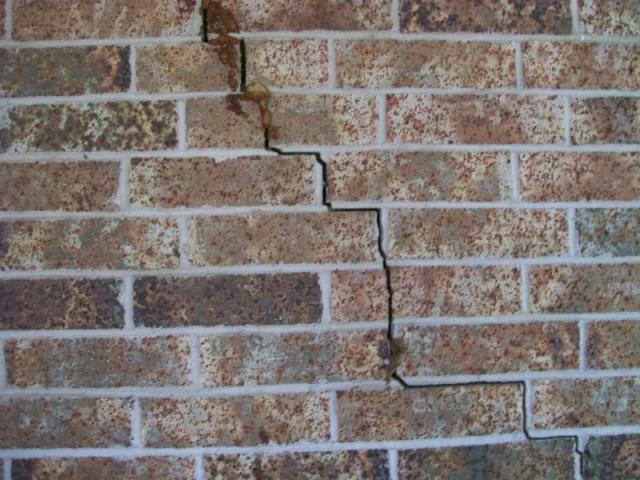
There you are one early morning, in the pool swimming laps, on your bike cruising down country roads, or out for a long run through the backstreets. You had a plan, you set your distance, knew your route and were off. But half way through your workout, your arms stopped rotating like a windmill, your legs resembled the rubber chicken sitting on the corner of your desk, and your body slumped into something you liken to the compost pile in your backyard.
It’s happened. You’ve hit the wall.
This can be dismaying, to say the least, especially when you thought you were doing fine and felt like you were in great shape to be out there rolling.
What causes us to hit the wall and what can we do to prevent hitting it? It seems to me there are three important factors athletes—yes, even amateur athletes like most of us—need to consider before we hit the dawn running.
Nutrition
If your body was like Janet Jackson, it might sing you a song: What have you done for me lately? (And if your mind is like mine, you get a song stuck in your head whose words you either don’t like or can’t remember, but you sing it to yourself anyway, making up different words to suit your situation. Like what did you eat for me lately?)
The question is a serious one. What did you fuel your body with before your workout? Before, in my mind, is not only the 30 to 60 minutes before you head out the door, but the long stretch of hours that lead into your workout, the night before if you work out in the morning or the entire day if you work out in the afternoon or evening.
I work out first thing in the morning. I always eat a small meal 30 minutes or so before my workout, but I am also cognizant of what I eat the night before. If I am doing cardio in the morning, I make sure I eat complex carbs with dinner. And if I’m hungry before I go to bed, I eat. Your body needs the right balance of proteins, fats, and carbs, complex as well as simple, to function at its best. Don’t deny it what it needs.
Hydration
If you feel thirsty, it’s already too late. You’re dehydrated. What do you do? Drink, drink, drink! Drink before you go to bed, drink before and after your workout. Drink always, all day long.
Notice I didn’t include the middle of your workout as a time to drink. That depends on what you’re doing and how long you’re doing it. I always have water with me when I bike, swim, and weight train. I drink frequently during all of these activities. But I don’t take water with me when I run unless I plan to be out there more than 60 minutes. I know there are some people who would say, so what? Take water anyway! For me this is simply a personal preference. I don’t like holding things in my hands or feeling extra weight hanging on my hips when I run.
What do you drink? Water. Lots of it. Sports drinks are unnecessary for most people, unless you’re out there sweating profusely for long periods of time. If you’re training for a marathon or a triathlon, especially in summer in Texas, that’s a different story. Kind of. I prefer coconut water over sports drinks because sports drinks have a lot of sugar in them. Coconut water has none. It’s a great way to keep hydrated or to rehydrate.
Muscle fatigue
It could be that you hit a wall because your body is just plain tired. Have you slept enough? Have you over trained? Does your body need rest for a few days? Should you stop what you’re doing at the moment, or should you push through?
That depends.
The way you get to know your own strength, to find out what you’re made of, and to improve your endurance is to push yourself beyond what you think are your limitations. Sure, I can stop when my knees get wobbly or turn into lead pipes. I may even have to stop. But at what point do I make this determination?
Ask Socrates. He’d probably say Know Thyself. Part of training hard and pushing yourself to be better, stronger, faster than you were before (like the Six Million Dollar Man) is knowing your body well enough to understand what it’s trying to tell you and to respect it enough to listen. There’s a fine line between breaking through the wall and breaking your body. The first is exhilarating. The second excruciating. Unfortunately, sometimes we learn to recognize our body’s queues through trial and error. When we err, it hurts.
Inevitably, at some point in training, you’ll hit a wall. If you pay attention to your body, it will let you know why you hit it and what to do about it. Listen to it. Your body knows best. Almost like your mother.
Read Full Post | Make a Comment ( 3 so far )Gratitude. It’s what’s for breakfast.
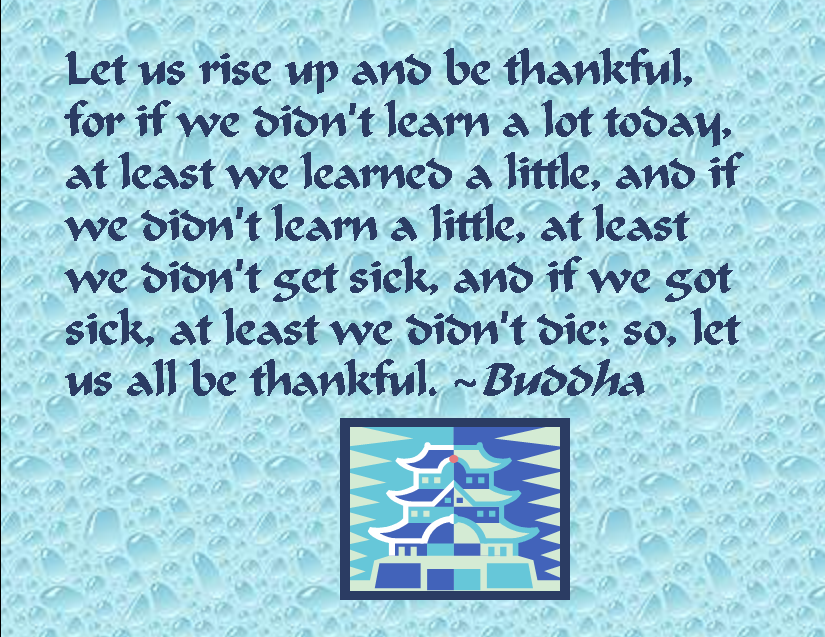
I don’t always jump out of bed with a happy smile on my face. Some mornings I don’t even want to roll out and frown. I have my share of days when I dread getting out of bed, and sometimes I even dread the thought of running.
But one of the things I love about running is the remarkable way it transforms my attitude, usually from cranky to grateful. Most morning runs are like that. My time outside results in more than the physical benefits I get from running. Running shows me gratitude.
By the end of my run, I usually have a mental picture of all the things I am grateful for. Some of them look like this:
G od. For making me. Able.
R obert, my boyfriend.
A ll my family and friends. Even the cranky ones.
T oday, because it’s all I have for certain.
I ce cream.
T omorrow, because with it comes promise and hope.
U rsa Minor. Or pretty much any constellation.
D ogs. Mine: Smaug and Queequeg.
E ars to hear. Eyes to see.
Does running do the same thing for you? What are you grateful for?
Read Full Post | Make a Comment ( 4 so far )What Running Could Teach a Girl
I want to show girls how running teaches them things that can change their lives.
I hear that sentiment a lot as I talk with women who want to become coaches or other volunteers for Girls on the Run. I smile every time because I understand just what they mean. Now.
There was a time, however, when hearing such a thing struck me as completely ridiculous. How could running teach a person about life? All it seemed to teach people was how to sweat a lot and injure muscles and ligaments I had never heard of. How does limping through life with wet socks and undergarments teach anyone anything useful about living? Sheer craziness, I thought.
Until I ran. Now, I am a runner.
Did you notice the way I phrased that? I am a runner. I did not say that I became a runner, or that I learned to run, although both statements are true. Instead, I chose a phrase that defines a present, permanent, pervasive state of being. You could almost call it an inhabitation. Now, it is quite natural for me to say this: I am a runner. For a long time, it was not.
I often think about why that is the case. People frequently ask me if I am a runner, and it always startles me. For some reason, I don’t expect it to show. I know that many runners have identifiable physiques, as do jockeys and sumo wrestlers, but I don’t think it’s the association with a particular body type that surprises me.
Maybe it’s because for me running is not about the body anymore. It’s about the soul. And to ask if I’m a runner means that in some strange way the most private part of me has been made public. A clearly unsettling prospect for anyone. Unsettling, and life changing.
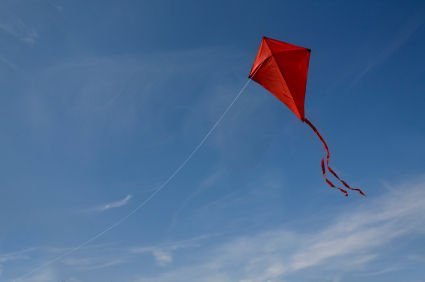
Running didn’t show me that I had a soul (I’d like to believe it was already there), it made me understand that what I needed to succeed in this life—what I needed to make healthy and loving choices, to be strong and confident and at peace—was already there inside me. Running helped me to tap into it and pull it out, unfold it and put its pieces together, like the kite you might get in your Easter basket, ultimately billowing high above the earth but tethered to you by a string.
And that’s what these volunteers want the girls to see. That they already have at least the pieces of everything they need to live a happy, healthy life right there inside them.
If they can get the girls to take just one step, to move forward just a little, the girls will learn to trust the voice they hear inside when they run. Eventually, the girls will run into themselves.
And maybe some of them will one day say, I am a runner.
Read Full Post | Make a Comment ( None so far )Anger Management, or how running could save the world
I’ve been feeling a bit out of sorts for a week or so. Not physically—I’ve been doing a lot of strength training, circuits, and swimming—but mentally. Emotionally. Spiritually. Whatever you want to call the blend of those other essences that make us who we are. Something simply hasn’t been right.
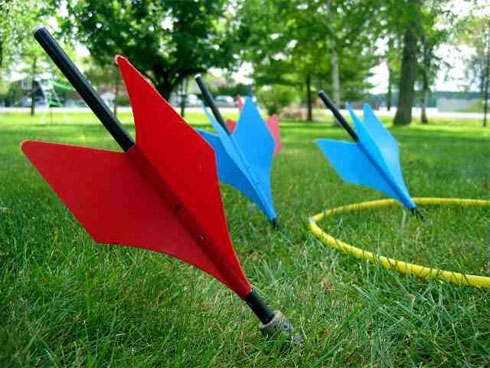
I don’t like it when something isn’t right and I can’t identify it. I feel it in my diaphragm, mostly, that space between the stomach and the heart, both of which are inevitably effected, like someone has been playing lawn darts in there and abandoned them where they stuck, and I’m left walking around dragging daggers behind me.
I’ve spent so much time in the gym these past two weeks that until this morning I haven’t been outside to run—just run and nothing more—for nearly 10 days. So yesterday, I set out from my house before dawn, alone. My favorite time and way to run. I always say that, always remember it, know it in my head, but I believe I actually forget the real reason why I love it until I’m out there running.
When I set out alone in the wee hours, I dragged the darts behind me. The heaviness made me angry. I didn’t realize this until I was about a mile and a half down the road, looked up from my reverie, and thought, how’d I get here already? I felt my legs moving fast and my body standing stiff and tall and I recognized that it was the quickness of anger that moved me.
But angry at what? is what I wanted to know. It’s been a good week—all seems right with the world, on the whole—and I couldn’t place the anger. So I kept running, letting my anger and the darts propel me down my path, until an amazing thing happened.
Somewhere between miles 2 ½ and 3, the darts fell away and my anger dissipated. Why? Because somehow, simply in the act of running, I found an answer. The issue that had twisted me all out of sorts had a name. Anger wasn’t the real issue, it was a symptom, and I could suddenly identify what it was that had been bothering me. I didn’t yet have a solution, but the issue finally had a name.
This, I was overjoyed to remember, not only in my head, but in every limb and organ in my body, is why I run. Alone. Before dawn.
There is nothing more therapeutic than pounding the pavement, letting whatever it is that ails you have the space to actually ail. By the end of my 5 mile run, I knew what the problem was and how to address it. What a relief.
And what a reminder. I need to run alone before dawn more often. Simply to keep clear and balanced.
Now, if we could get the whole world running, imagine what kind of problems could be solved.
Read Full Post | Make a Comment ( 2 so far )What Would Barbie Do…in the Olympics?

from Economic Times, India Times
I love the Olympics. And although I root for the USA in every event they participate, I have to admit that what I watch for is not necessarily nationality, it’s ability. The athletes who make any Olympic team are extraordinary. Watching them gives me goosebumps at the least, and sometimes brings me to tears. The perfection and grace of movement in rowing, diving, sprinting, pole vaulting, gymnastics is simply stunning, particularly since the athletes make what they’re doing look so effortless. It’s easy to forget all the blood, sweat, and years, all the training and discipline and sacrifice that lead to this one event. It blows me away.
So when I heard comments about Gabby Douglas’s hair, I was, well, perplexed. Here is a woman who won the gold medal in the gymnastics all-around event and is a member of the U.S. team that won a gold medal—the first team gold for the U.S. since 1996—and people are talking about her hair?
It gets better. Some people are actually calling some Olympic women athletes fat. That’s right. Olympic athletes—some of the fittest people on earth—fat. It doesn’t seem to matter that they’re bodies are conditioned to support them in their chosen field. It doesn’t seem to matter that many of them set or break records. What makes the news is that some swimmer or sprinter doesn’t look as “fit” as in the last Olympics. Or that another one is “carrying too much weight.”
And we wonder why so many girls have eating disorders or body image issues when even the fittest of us are scrutinized as if we were a side of Kobe beef.
I wish I could say I am surprised, but, sadly, I am not. This Olympics marks the first time women are competing in every event, and from every country. This year also marks the 40th anniversary of Title IX in the U.S., the law that opened the door for women’s participation in sports where they did not have access before. Undoubtedly, more women are competing at a higher caliber because of the opportunities afforded by this law, yet those discussions and those women are not what’s making the news.
Perhaps coincidentally, another story making the news this week has to do with Barbie, the 53-year-old who never ages. Now, I played with Barbie as a kid. She usually teamed up my brother’s GI Joes to battle the evil Rock ’em Sock ’em Robots. But it never occurred to me to see her form as an aspiration. In my mind, that would have been like trying to force myself into the shape of a pine tree or something equally ridiculous. I just wasn’t made that way, and, alas, I lacked the Wonder Twins super powers.
Model Katie Halchishick decided to make a point this week. She marked her body with dotted lines, the way a plastic surgeon marks bodies before rearranging them. The lines correspond to what a Barbie doll would look like in real life.
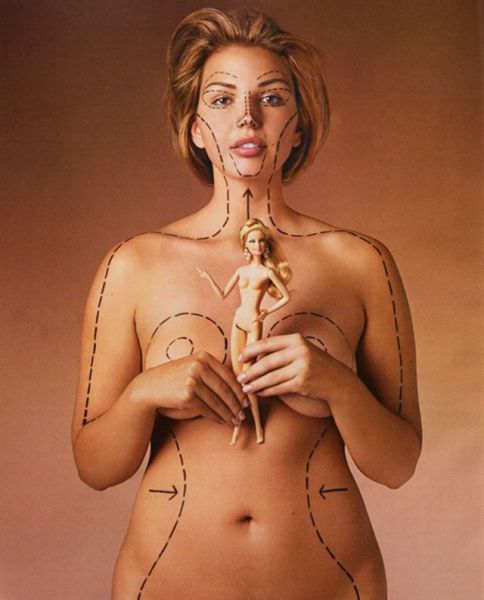
Scary. Unnatural. Those are only two words that come immediately to mind.
Yet the figure and hair and makeup of Barbie is what some people seem to want to see soaring over the vault or flying across the pool at the Olympics. But with a body like that, what, exactly, could Barbie hope to do in any athletic event, much less at the Olympics? Her thin little arms couldn’t support her on the uneven bars. Her skinny little waist could never contain the strong core muscles to lift her body over the hurdles. And that scrawny (scary) neck? It doesn’t appear that it would hold her head up high enough to see the crowd.
When I see someone like sprinter Sanya Richards-Ross moving like the wind across the track, her muscular body rippling with the effects of all that training, and then hear someone ask, what’s up with her hair, I can’t decide whether to laugh or scream or cry.
Read Full Post | Make a Comment ( 4 so far )Running to Freedom

In honor of the 4th of July, I’d like to share a story about my dad, who loved America and, consequently, loved the 4th of July. It’s not a story about running in the literal sense, but it is nevertheless a story about running.
My dad was a Freedom Fighter in the 1956 Hungarian Revolution. Hungary at the time was Communist; the revolution was designed to overthrow Communism and establish democracy. Like most revolutions of its kind, it was short lived, lasting only 10 days, and it was led by the country’s youth. My dad was one of them, barely 16 years old, when the tanks rolled in to Budapest to squelch the uprising. It didn’t take long for the Communist army to put down the revolt. By the end of it, if you were one of the organizers, one of the fighters, you had a choice: Spend the rest of your life rotting in a horrible prison (that is, if you weren’t killed) or run. My dad chose to run.
He left his home—his mother and little sister—in the middle of the night. He didn’t tell them he was leaving. He knew his mother would beg him to stay and he’d not be able to resist, so he wrote a letter instead and left it in the mailbox. He didn’t say where he was going, exactly, partly because he wasn’t quite sure and partly because he realized that the less his mother knew, the better.
He took most of the money he had saved, leaving a good chunk for his mother, and wheeled his bicycle quietly away. His girlfriend, Marika (which is, coincidentally, my sister’s name), who was even younger than him, waited in the shadows outside her own house. They stole through the side streets and alleys, out of the city, and into the open fields in the general direction of a train they hoped would take them to Austria, where they could begin to find freedom.
My dad’s flight out of Hungary was harrowing and with enough drama to fill a book. In a nutshell, although he made the train, he was forced from it in the middle of nowhere, where his money was stolen and his girlfriend betrayed him. He was left with virtually nothing, but eventually managed to make his way to Michigan, where he tracked down his father. My grandfather too had been forced to leave Hungary, right after WWII, and my father hadn’t seen him, his own father, in a decade.
My dad told me his story of escape more than once before he died in 1993. I think of it often, yet there are two images that stick with me. When he was forced from the train in the dead of the night, my dad found himself in a field pretty close to the Austrian border. Hungary at the time had a vested interest in keeping her citizens to herself; the borders were surrounded with armed soldiers with shoot-to-kill orders.
So when my dad left the train and trudged through field after field and finally saw the border, when he knew that if he made it, he’d made it to freedom, he ran. Of course the soldiers did what they were ordered to do: They fired. This is the image I carry with me. A young boy running across a field as fast as he can, supported by thin, tired legs nearly spent from lack of food and water, but suddenly so wired by adrenalin that they do what human legs are designed to do. They run. They carried him away from danger, away from the machine guns exploding around him like a string of firecrackers and toward safety.
Sometimes when I am running, my mind takes me to this place, this field showered by machine gun fire and a boy running for his life, and it leaves me breathless. I am thankful it is I place I can only imagine and not a place I have lived.
The other image I carry with me is this. My dad lost everything on his journey to America. When he arrived here, all he had was a paper bag containing a tie and 2 oranges. He was so happy to be here that before he stepped onto American soil he put on his tie and gave away his oranges. I picture my dad, a gangly pimple-faced kid in crumpled clothes, adjusting his tie, smiling huge at all the strangers passing by. It makes me smile too.
I am thankful that my dad’s love for America was contagious. I suppose it is no wonder I would become an English professor who taught American literature. It is stories, after all, that make us who we are and shape us into what we will become.
Read Full Post | Make a Comment ( 2 so far )Flag Day Inspiration

Thursday, June 14, was Flag Day. I was privileged to attend the celebration of two people who became permanent U.S. residents, a mother and daughter from Haiti. I know B, the daughter, through Girls on the Run. I have seen her run. I have seen her cross the finish line in two races. For a long time, however, B could not run.
B came to America about 2½ years ago at the age of 9 after the devastating earthquake that shook Haiti to its core. She came alone, on a stretcher, to a country she did not know and one whose language she did not speak.
B and her mother, R, were close, and R did everything she could to give B a great life in Haiti. They both valued education. To this end, R ensured that B had the best teachers in Haiti, even though that meant that B’s school was too far away for her to walk to. However, if it had been close enough for most children to walk to, B could not have made it there. She had an illness that often left her debilitated and prevented her from walking.
R did everything she could to find treatment for B. They went to many doctors in Haiti, but the doctors could find no cure. They went to traditional healers, but B could not be healed. So they prayed, but B did not get better. They were baffled and frustrated as B continued to suffer.
When the earthquake struck, B was at her school, studying. The building collapsed, killing many, including B’s friends and teacher, and leaving B’s leg pinned under debris. Trapped for hours, she lay under the rubble and called for help.
In the middle of the earthquake, R’s thoughts were of her daughter. With tremors still shaking the island, R made her way to her daughter’s school, only to find it destroyed. Trusting that B was still alive, R dug in the rubble with her bare hands. B continued to call out for help until her mother found her. Soon, B’s uncle, and then the entire village, was there to uncover B.
When they dug her out, B’s leg was completely crushed by the weight of the building. Although she spent time in the hospital, a terrible infection set in. Doctors prepared to amputate B’s leg.
But what B didn’t know was what was happening over 1000 miles away. Her soon-to-be foster family—3 young girls and their parents—watched the crisis in Haiti unfold. Moved by the devastation, one of the girls spoke up first and asked if they could adopt one of the many injured children.
That was the first step in what would take a web of strangers—doctors, charities, and private citizens—to bring B to San Antonio. R was strong enough to choose hope for her daughter, and sent her off alone. B was courageous enough to leave. It would be an entire year before B could be joined by her mother.
Through the efforts of remarkable doctors, B’s leg was saved. She underwent a series of painful surgeries, without whining, without complaint. What’s more, her doctors diagnosed the disease that had limited B throughout her life. Fortunately, it’s one that can be successfully managed.
Finally, B is pain-free.
Almost two years after B arrived, I had the privilege of seeing her run. At the time, I didn’t know it was a privilege. At the time, I didn’t know her courage and her strength. I only saw a girl running.
I don’t think B knows that her bravery has fingers long enough to touch virtual strangers.
At the celebration, I chatted with a friend of the family. She said that when she told B what an inspiration she was, B said, “What’s an inspiration?” On Flag Day, in the Federal Building, surrounded by the web of people whose faith and love and hope crystallized into action, there were too many inspirations in the room to count.
Read Full Post | Make a Comment ( 1 so far )The Art of Swimming, or how Ben Franklin helps me train
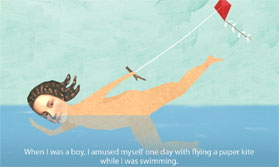
Any time I think of Ben Franklin—and yes, oddly, I think of him a lot—it’s never as a swimmer. Yet there I was in the pool this week working on my stroke when who should I think of but Franklin.
Franklin has been one of my heroes, I suppose you could say, since I first read his Autobiography in high school. (I know. I was an odd kid.) What appealed to me about Franklin then appealed to me throughout college and well into now. Franklin was all about self-improvement. He was a planner, a list-maker, an organizer of days and details, who believed that hard work, patience, and discipline lead to progress.
He went so far as to devise a character development project—The Art of Virtue—in the hope of attaining “moral perfection.” To this end, he listed 13 virtues or qualities of character he felt most important, with an explanation or precept beneath each one. He made a chart listing the 13 virtues down the side and the 7 days of the week across the top. Each week, he focused on one virtue.
He carried his chart with him everywhere he went, and each time he failed to live up to that week’s precept, he’d make a mark on the chart. The fewer the marks on the chart, the closer he came to meeting his idea of moral perfection. The next week, he’d focus on the next virtue, and then the next, until he worked his way through all 13. Then he’d start over again.
He kept his chart for 50 years. He never quite reached moral perfection (I highly doubt he ever thought he would), but he became a better man by marking himself through life.
So why was I thinking about moral perfection while swimming this week? I wasn’t. I was thinking about my elbows. Was I lifting them high enough out of the water? Were they coming up in the shape of a pyramid? Or maybe a chicken wing wrapped tightly to the body strapped on a rotisserie, turning maybe 75°, but not quite all the way around, just enough to twist my body up and around to take a deep breath of air? (I know. I am an odd adult too. Sometimes I get hungry while I swim. Usually, I think of oranges. This time, it was rotisserie chicken.)
My elbows. That was my focus, just for this week. Last week it was my kick. Next week it will be something else. Each time I get in the pool I try to practice proper form, but I realized this week that I focus on only one thing. Enter Franklin.
I won’t go so far as to make a list of 13 swimming components I need to improve, but I have one in my mind. In all other endeavors I have undertaken that involve self-improvement, I have made a plan—created a list, kept a calendar, somehow marked my progress and lack thereof. I have done this, in part, to keep from being overwhelmed. A project is always easier to undertake if I break it down into smaller parts.
Triathlon training is easier to undertake if I break it down into smaller parts.
I don’t have to master the art of swimming in just one week. Not even in one month. There are too many components to take into account, at least for me. But if I focus on just one thing at a time—just one week at a time—I will at least get better. And all I ask for is improvement.
So thank you, Ben, for once again reminding me that improvement comes in small measures, over the course of time.
I said that before this week, I had never thought about Franklin as a swimmer. Heck, I never thought of him as athletic at all. Come to find out, he not only taught himself how to swim in a time when almost no one went swimming, but he invented fins. He is, in fact, the only founding father to be in the Swimming Hall of Fame. I wonder what his training log looked like.
Read Full Post | Make a Comment ( 2 so far )In Medias Res
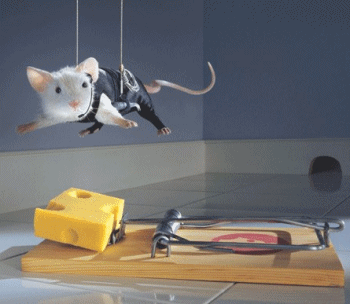
This post is longer than usual for me, in large part because it’s a complicated subject for me. I suspect it is for others too. Goals. Not goal setting, which many of us do, but goal revising, which many of us stop short of doing and choose instead to call our missed goals failures.
I have set my share of goals, most of them fitness-related, especially in the past decade. (Note: When you start talking about your life in terms of decades, you know you’re getting old.) Sure, I have set work-related goals. For the most part, they’ve been called deadlines. To my way of thinking, that’s not quite the same thing as setting goals.
Many people use New Year’s resolutions as their goal-setting strategy. But the idea of making resolutions has always bugged me—why pressure myself to set goals during this monumental goal-setting time once a year? And if January passed and I hadn’t resolved to do much of anything, I was off the hook for another year, drifting about on the Nonplan Plan, which is what I did for a year or two. Maybe three. Which is, perhaps, why New Year’s resolutions bugged me.
I know a bit about goal setting and time management. I’ve taught the principles and the actions and I know what I’m supposed to do: Set big (challenging), specific, measurable goals with realistic deadlines, long and short. Write them down. Read them regularly. But other than fitness-related training goals with the requisite plan tacked on my refrigerator, I hadn’t written down any goals. Instead, I kept them in my head. Picked a vague date. Figured I’d make it. Or not.
So this past January, I tried something new. I made two lists, one of priorities and the other of short- and long-term goals, and taped them to my bathroom mirror. They were the first thing I saw every morning and the last thing I saw every night. And since I work from home, I saw them a number of times in between.
I listed my priorities first. My goals wouldn’t mean much unless I knew what larger picture I was trying to paint. Additionally, no matter what I have planned on any given day or week, life happens. The time or effort I have to put toward my goals often conflict, and I have to choose. Reminding myself of my priorities makes it easier to know what choice to make. At least in theory.
My priorities, listed in order of importance, looked like this:
- God
- Health
- Relationships
- Writing
- Work
My logic went something like this: Life is not about me, it’s about serving others (God). In order to serve others to the best of my ability, I need to take care of myself (Health). The things in life that mean the most to me—the things I serve—are not things, they’re people (Relationships). The abilities, skills, and passions I have to serve others with are gifts, and gifts are meant to be opened, not kept under wraps. I am blessed with the gift of writing—what can I do with my writing to help others see (Writing)? I am blessed with the ability to run—how can I extend my life-altering passion to others (Work)?
Under each priority, I jotted down a few phrases about what the priority means to me. Under God, for example, one of the things I wrote is to keep my light on a table, not under a bushel. Under Health I wrote only one thing: You know what to do. Just do it. (Clearly, I have set the most goals in my life around this priority.)
Next, I wrote out some goals: 8 for the month of January—specifically under the priorities I knew I would struggle with most; five 3-month goals (end of March); three 6-month goals (end of June); and two one-year goals (end of December). I intentionally set fewer long-term goals, as I knew that 6 and 12 months were too far out to set very specific goals, and I would need to revise accordingly.
Revise accordingly. This is where I am now.
I achieved 7 of my 8 January goals. By the end of March, I achieved only 2 of 5. I am on track to achieve maybe 1 of my 3 June goals and maybe 1 of my 2 December goals. I took the papers off my mirror at the end of April. Not because I failed. But because I choose to succeed.
I fail now only if I choose to do nothing. I succeed if I revise.
Revision, as it turns out, can be pretty tricky. It’s a lot like what Ernest Hemingway said about writing: “There is nothing to writing. All you do is sit down at a typewriter and bleed.”
Revision means not only reevaluating your goals, but why you set those goals in the first place. The goals that I haven’t met, for instance, can be lumped into two categories: those that depend on others to achieve and those that have to do with writing. Once I can see a pattern emerge—two categories—I can figure out how to revise.
Goals that depend on others to achieve, as it turns out, are not really goals. At least not my own personal goals. Unless I checked with those “others” to see if their goals align with mine. If I haven’t, then I’ve set unrealistic and probably immeasurable goals. Every single goal I missed in this category has to do with work.
I feel so passionate about the mission of my organization and I see very clearly in my mind where I believe we need to head. My vision, however, doesn’t match my past few months’ experience. Does this mean that I should ditch the organization and our goals because we’re not where I wanted to be?
Hardly. Rather, I can use life experience to reshape not only our goals, but my goals. I can learn what to measure, understand what’s realistic, and check with others first. Then I can set new goals, making sure to set goals that are “mine,” not “ours.” There is most certainly a place for “our” goals, but that place is not necessarily on my bathroom mirror.
The other category of goals I didn’t meet has to do with writing, which is pretty high on my list of priorities. It’s the first of things I “do” after things I “am.” In other words, it’s action rather than character. Sort of. Because I am, and have always been, a writer, whether I have been a paid writer (sometimes) or not (most of the time). Writing, writers know, is part of one’s essence.
If a priority is that high on my list and I fail to meet most of the goals associated with it, then, as painful as it might be to even suggest it, maybe my priority is not really a priority. My boyfriend reminded me of this indirectly just the other day. I can’t very well get my book published if I’m not sending it out to agents. And I can’t get a novel published if I haven’t yet finished writing it.
So why haven’t I been doing the things I know I need to do—that I really want to do? In part, it’s because of competing commitments and accountability. If there are X hours in a day and I have set aside a block of them to write but a work issue arises that needs to be addressed immediately, there goes writing time. Two goals—two priorities—competing for the same block of time. Which one wins?
Technically, it should be the higher priority on my list. In this case, writing. Practically, what wins is the priority that serves the most people, most immediately: Work. At work, I am accountable to over 100 girls, 30 coaches, 5 sites, and whoever reaches out for information. In writing, I am accountable to only me.
And it’s this thing called accountability that often causes the bleeding and makes us feel as if we’ve failed when the deadline for a goal has passed with the goal unattained. We are, in the end, always accountable to ourselves. Goals are, after all, ours. We set them.
Who says we can’t revise them?
Revision is part of progress. How do I know where I’m going if I don’t know where I am or where I’ve been? I need to set my goals. Measure and monitor them. And when life happens, as it inevitably does—and thank God it does—revise accordingly.
I wish I could say I have done this already and that I have solved my dilemma of competing commitments. But I have not. I am in medias res, and in the middle of things is not such a bad place to be. I will figure it out. And if I’m wrong, I’ll revise.
Read Full Post | Make a Comment ( None so far )« Previous Entries Next Entries »
 More Than Running...